Trained teachers: quality at the heart of learning
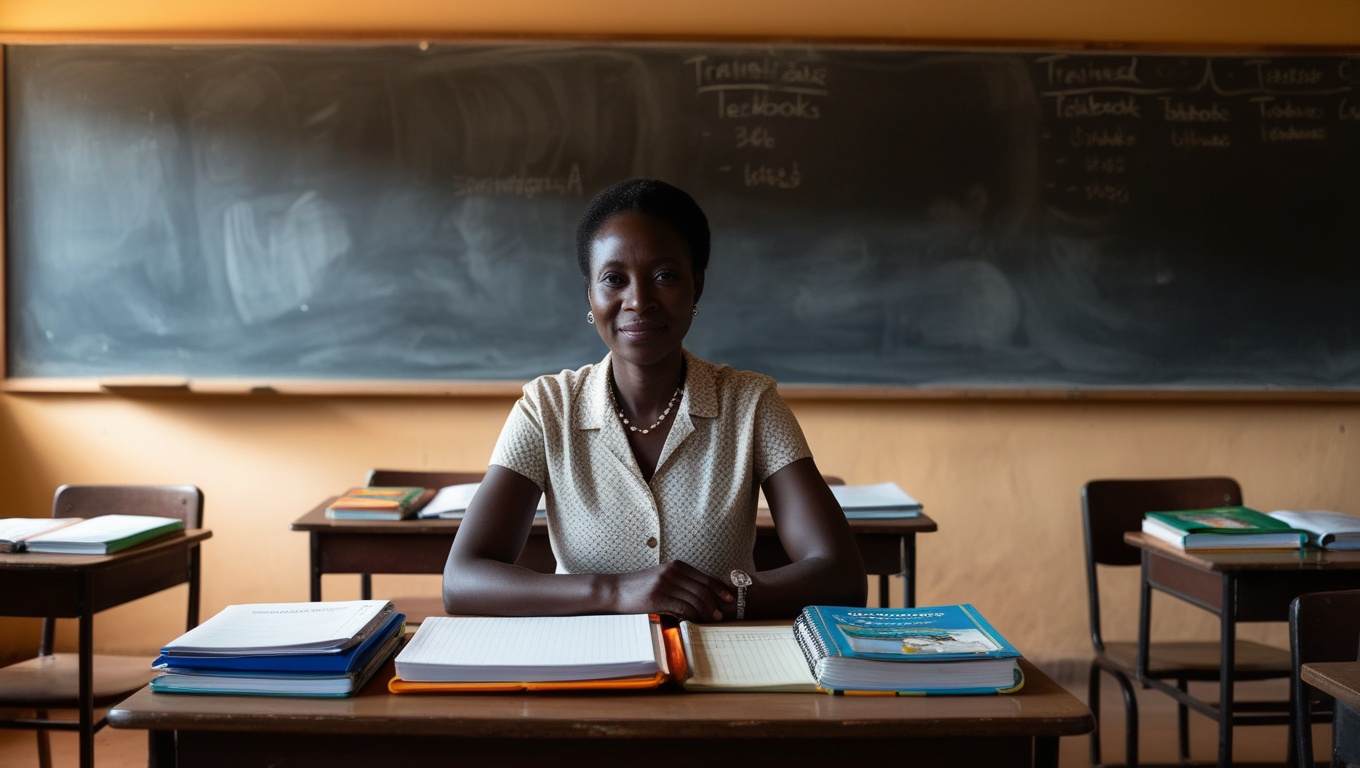
No education policy is worth more than the teachers who deliver it in the classroom. Yet sub-Saharan Africa is today the only region in the world where the share of trained teachers has declined: from 84% of the primary corps in 2000 to 65% in 2019, while the global average holds steady at 85%. This single figure sums up a silent crisis. As states multiplied classrooms to absorb an exploding school-age population, they hired barely trained or untrained teachers in haste, diluting the very quality they claimed to be extending. The question is therefore no longer how many children are seated in class, but who stands in front of them, and what that child actually learns.
One region, dizzying gaps
Behind the sub-Saharan average lies a geography of inequality that few sectors can match. The latest UNESCO UIS data, taken up by the World Bank, place Niger at 98.8% of trained teachers in primary education (2024), Burkina Faso at 91.0% (2024) and Ghana at 89.3% (2024) at the top of West Africa. At the other extreme, Mali falls to 37.4% (2023), meaning barely more than one teacher in three has the minimum required pedagogical training. Between the two, Benin stands at 75.1% (2021) and Nigeria, which hosts the largest teaching corps in the region with more than 913,000 primary teachers, at 62.2% (2018). A ratio of more than 1 to 2.6 thus separates the first from the last. This dispersion tracks neither the wealth of countries nor their climate: it tells the story of public policy choices, national definitions and recruitment trajectories. This is good news, because what stems from choice can be corrected.
The only regional decline in the world
The sub-Saharan anomaly deserves a closer look. While every other region has maintained or improved the qualification of its teachers, sub-Saharan Africa has lost nearly twenty points in two decades, falling from 84% of the primary corps trained in 2000 to 65% in 2019. Over the same period, the global average stood at 85% in 2023 according to the UIS. In other words, the gulf separating the region from the rest of the world widened rather than narrowed, precisely during the years when access to school was progressing fastest. This divergence is not a statistical accident: it reflects a deliberate trade-off, that of favouring the quantity of places over the quality of supervision, in a context of budgetary constraint and demographic pressure.
Sub-Saharan Africa is the only region in the world where the share of trained teachers has declined. It expanded schooling faster than it trained those who teach it.
The mechanism: hire fast, train later, or never
The decline in training is no mystery. It follows a well-known mechanism: when the school-age population grows faster than the capacity of teacher-training colleges, states fill the gap with emergency recruitment of contract teachers, often barely trained or untrained, less well paid and employed on precarious contracts. Each wave of unqualified recruitment mechanically dilutes the share of trained teachers in the corps, even if the absolute number of qualified teachers rises. The definition used here is UNESCO's: a trained teacher is one who has received the minimum pedagogical training, before taking up the post or in service, required by their country. This threshold, already modest, is today met by only two teachers in three in the region.
- Demographic pressure. Demand for schooling grows faster than the capacity of teacher-training colleges to train, pushing states to recruit unqualified staff in order to open classrooms on time.
- Contractualisation. The massive resort to contract teachers, cheaper but often without pedagogical training, mechanically dilutes the share of trained teachers at each recruitment campaign.
- Sacrificing the secondary level. The dual qualification required at secondary level, rarer and more costly, is the first to be abandoned under budgetary pressure, widening the gap with the primary level.
Benin's trajectory illustrates this fragile balance. The country has come a remarkable way, rising from 40.4% of trained primary teachers in 2009 to a peak of 77.0% in 2020, the fruit of a sustained professionalisation effort. But this summit did not hold: the share fell back to 75.1% in 2021. This slight retreat, after more than a decade of continuous progress, is a reminder that gains in training are never final. A single wave of unqualified recruitment, or a slowdown in continuing training, is enough to reverse the curve.
Very uneven rates of catch-up
Comparing national trajectories over time is the best antidote to fatalism. Over the recent period, Ghana offers the most spectacular example: starting from 50.6% of trained primary teachers in 2010, it reaches 89.3% in 2024, nearly forty points gained in fourteen years. Senegal, more steady, progresses from 47.9% in 2010 to 77.1% in 2024. Togo, already relatively well endowed at the outset (76.7% in 2010), consolidates its position at 81% in 2024. Three neighbours, three rhythms, but one and the same lesson: where the training effort is sustained over time, qualification progresses markedly. The Ghanaian acceleration, in particular, demonstrates that massive catch-up is within reach of a determined policy, and not the privilege of the wealthiest countries.
The secondary level, the blind spot of policy
While the primary level concentrates the attention of donors and enrolment campaigns, the secondary level is the great forgotten of teacher training, and it is there that the drop-off is most alarming. In Benin, the share of trained teachers falls to 35.6% at secondary level (2022), against 75.1% at primary level: in other words, more than two thirds of the secondary teaching corps has not received the minimum required training. The phenomenon is not specific to Benin. Niger, exemplary at primary level with 98.8%, drops back to 52% at secondary level; Mali stagnates at 40.5%. Only Ghana maintains a high level at both stages (82.9% at secondary level). This drop-off has a logic: teaching secondary-level subjects requires a dual qualification, academic and pedagogical, rarer and more costly to build, which emergency recruitment sacrifices first.
The cost of inaction shows up in learning
An untrained teacher is not a statistical abstraction: it is learning that does not happen. The most brutal consequence of the qualification deficit is learning poverty, the indicator that measures the share of 10-year-olds unable to read and understand a simple text. In sub-Saharan Africa, this rate reached 89% in 2022, against 86% before the pandemic: the region thus went backwards at the very moment the world was trying to recover. Nine children in ten there reach the end of the primary cycle without mastering the fundamental skill on which the rest of their schooling rests. No curriculum reform, no textbook, no new building compensates for a teacher who has not learned to teach reading.
Here again, regional averages mask sharply contrasting national situations. Of the nine countries studied, Benin has the lowest learning poverty at 55.8% in 2019, far ahead of Niger, where 90.4% of 10-year-olds cannot read a simple text. Between these two markers lie Senegal (68.6%), Burkina Faso (73.9%), Cote d'Ivoire (79.9%) and Togo (81.7%). The fact that Benin combines relatively contained learning poverty with an honourable share of trained primary teachers is no coincidence: the quality of supervision carries over into the quality of learning.
The countdown: 15 million teachers to recruit
The challenge is only beginning. According to UNESCO's Global Report on Teachers, sub-Saharan Africa will need to recruit 15 million additional teachers by 2030, on its own about a third of the global deficit estimated at 44 million. This figure carries a formidable risk: if this recruitment is done, as in the past, in haste and without adequate training, it will reproduce on a large scale the dilution of quality that has driven the region backwards since 2000. The teacher deficit is therefore not merely quantitative. It is the moment of truth where either a virtuous cycle of mass professionalisation or a new decade of precarious recruitment will play out. The difference between the two scenarios rests on the capacity of teacher-training colleges and continuing-training schemes to scale up before, and not after, the recruitment wave.
What averages conceal: overcrowded classes and misleading definitions
A high share of trained teachers is not enough to guarantee quality teaching, because it says nothing about the number of pupils each one must supervise. In sub-Saharan Africa, there are on average 58 pupils per trained teacher in primary education (2019), a ratio that climbs well above the raw pupil-teacher ratio, precisely because part of the teaching corps is unqualified. The secondary level, seemingly better off with 43 pupils per trained teacher, itself conceals the qualification drop-off already described. A trained teacher facing eighty pupils cannot teach as they were taught: overcrowding cancels out part of the benefit of training.
A second trap lurks in reading the rankings: national definitions. Cote d'Ivoire reports 100% of trained teachers at both primary and secondary level throughout the recent period. This perfect ceiling most likely reflects not a pedagogical reality but a statistical convention in which every recruited teacher is, by definition, counted as trained. One must therefore be wary of reading it as a quality ranking. This methodological caution is not an expert's detail: it conditions the reliability of any decision based on these figures. Comparing countries that do not measure the same thing risks rewarding a generous definition rather than a genuine effort.
Beyond definitions, national averages finally erase the most glaring internal disparities, between urban and rural areas, between public and private schools, between subjects. It is in rural areas and scientific subjects that trained teachers are most lacking, precisely where they would be most decisive. A reassuring national rate can thus coexist with entire pockets of schools staffed by unqualified personnel.
The CRAD angle: linking training, supervision and measured learning
The quality of teaching cannot be decreed, it is measured, along a chain that runs from initial training all the way to the learning outcomes observed in the classroom. It is this chain that CRAD documents in nine West African countries, through monitoring and evaluation systems and digital data collection. By linking three indicators too often treated separately, the share of trained teachers, the number of pupils per qualified teacher and the learning outcomes actually achieved, the firm enables states and donors to target training where it produces the most impact. This angle changes the nature of public decision-making: it is no longer about distributing training hours at the whim of programmes, but about concentrating them on the levels, areas and subjects where the deficit weighs most heavily on learning, starting with the secondary level, the blind spot of current policies.
This approach through disaggregated and geolocated data responds directly to the traps of averages. Where a national figure masks a rural school without a qualified teacher, fine-grained measurement brings it to light. Where a generous definition inflates a rate, confronting it with learning outcomes restores reality. Data is not an optional extra of education policy: it is its compass, the only one that can turn a training budget into verifiable learning gains.
The crux: financing without sacrificing quality
None of these recommendations holds without financing, and the order of magnitude is considerable. UNESCO estimates at 120 billion dollars per year by 2030 the additional financing needed, worldwide, for the salaries alone of new primary and secondary teaching posts. This figure lays bare the dilemma of West African states: recruiting en masse to absorb demographic growth, while training every new recruit, within a narrow fiscal space. The temptation of cheap but untrained contract recruitment is all the stronger as the need is urgent. This is precisely the calculation that data-driven steering can illuminate: showing that a trained teacher, even if more costly, produces a learning return incomparable with that of unqualified personnel, and that the apparent saving of precarious recruitment is paid dearly in learning poverty. The real cost is not that of training, but that of not training.
Financing also raises the question of equity, notably gender equity. The primary teaching corps is majority female in several countries of the region, but women less often access continuing training, mobility and secondary-level posts, where the qualification deficit is nonetheless concentrated. A professionalisation plan blind to gender risks reproducing these gaps. Targeting the continuing training of women teachers, particularly at secondary level and in rural areas, is one of the most cost-effective and most neglected levers of educational quality, provided sex-disaggregated data is available to steer it.
At bottom, the deficit of trained teachers in West Africa is not an intractable pedagogical problem: we know how to train a teacher, and several countries in the region prove it. It is a problem of political constancy and data-driven steering. The countries that progress are those that set a target, sustain the effort over a decade and measure their results where they matter, in the classroom. Those that go backwards are not short of solutions: they are short of a compass. Training teachers is not an adjustment variable of education policy. It is its first condition.
Key takeaways
- Sub-Saharan Africa is the only region in the world where the share of trained teachers has declined: from 84% of the primary corps in 2000 to 65% in 2019, against 85% globally in 2023.
- Regional gaps are massive: from 98.8% in Niger, 91% in Burkina Faso and 89.3% in Ghana to only 37.4% in Mali, with Benin at 75.1% and Nigeria at 62.2%.
- The secondary level is the blind spot: in Benin, only 35.6% of secondary teachers are trained, against 75.1% at primary level.
- The deficit is paid in learning: 89% of 10-year-olds in sub-Saharan Africa cannot read a simple text in 2022, from Benin (55.8%) to Niger (90.4%).
- The region will need to recruit 15 million teachers by 2030, a third of the global deficit: the risk is to reproduce untrained recruitment on a large scale.
Recommendations for West African decision-makers
- Set a national teacher qualification target by level (primary and secondary) and track it each year through a public, enforceable indicator aligned with the UNESCO definition of a trained teacher.
- Prioritise the secondary level, the blind spot of policy: bring the share of trained teachers up to the primary level, by developing the dual academic and pedagogical qualification in deficit subjects.
- Strengthen teacher-training colleges and continuing training before the 2030 recruitment wave, to prevent the 15 million posts to be filled from diluting quality once again.
- Measure pupils per trained teacher, and not only the raw ratio, in order to size recruitment where overcrowding cancels out the benefit of training.
- Build monitoring and evaluation systems that link training, supervision and measured learning, with data disaggregated by sex, by rural or urban area and by subject to target the effort.
- Secure multi-year financing of training rather than yielding to untrained contract recruitment, by documenting the higher learning return of a qualified teacher to justify the investment.
Sources
- UNESCO, The persistent teacher gap in sub-Saharan Africa is jeopardizing education recovery
- UNESCO, Global Report on Teachers: what you need to know
- UNESCO / Teacher Task Force, Global Report on Teachers: addressing teacher shortages (PDF)
- Teacher Task Force, Fact Sheet for World Teachers' Day 2024 (PDF)
- UNESCO UIS, Teachers (topic)
- World Bank, Trained teachers in primary education (% of total), indicator SE.PRM.TCAQ.ZS
- World Bank, Trained teachers in secondary education (% of total), indicator SE.SEC.TCAQ.ZS
- World Bank, Pupil-teacher ratio primary, indicator SE.PRM.ENRL.TC.ZS
- World Bank, Learning poverty (SE.LPV.PRIM)
- World Bank / UNICEF / UNESCO, 70% of 10-Year-Olds now in Learning Poverty
- UNESCO UIS, Pupil-trained teacher ratio by education level
- UN Sustainable Development, UN issues global alert over teacher shortage (2024)