Financial inclusion: how mobile money is reshuffling the deck
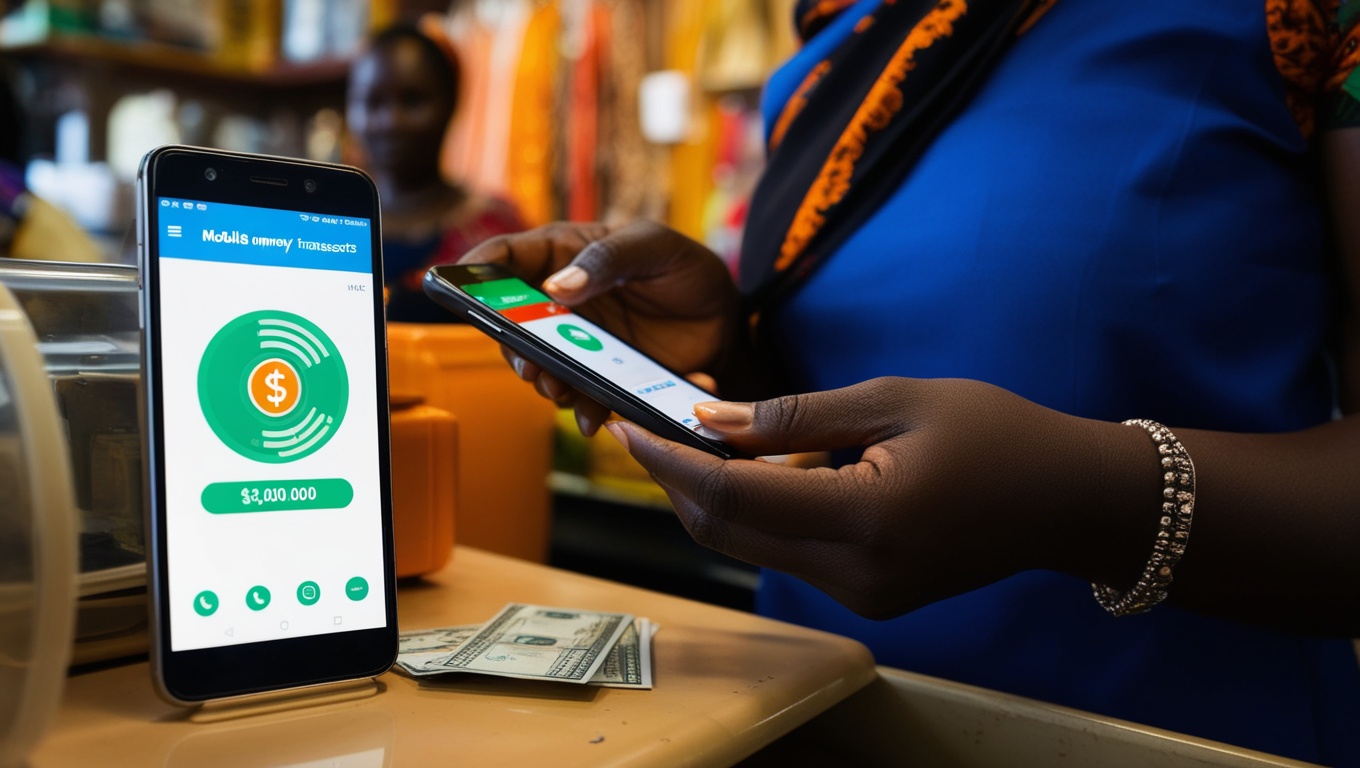
In a single decade, West Africa has achieved what conventional banking systems failed to deliver in fifty years: it has put a financial account in the pocket of most of its adults. The phone did the work of the branch. Yet as the region becomes a global reference for digital payments, an uncomfortable question arises: is this gain irreversible? The recent experience of Uganda, Ghana and now Senegal shows that a single fiscal decision can wipe out years of progress in a matter of months. The data therefore tell two stories at once: a spectacular catch-up, and a fragility that regional averages carefully conceal.
A decade that changed everything
Between 2013 and 2023, West Africa doubled the number of registered mobile money accounts, driven first and foremost by Nigeria, Ghana and Senegal. Across Sub-Saharan Africa, the share of adults holding a mobile money account rose from 27% in 2021 to 40% in 2024, thirteen points gained in three years, according to the World Bank's Global Findex 2025. This acceleration is not an isolated technological feat: it reflects a measurable leap in inclusion. In Senegal, financial account ownership rose from 5.82% in 2011 to 76.46% in 2024, a gain of roughly 71 points. Ghana followed a comparable trajectory, from 29.43% to 81.24%, while Nigeria advanced from 29.67% to 63.26%. In just over a decade, countries that started from almost nothing have reached inclusion rates worthy of advanced emerging economies.
What Africa's pace reveals, by comparison
The West African leap takes on its full meaning when placed within the global dynamic. It took mobile money twenty years to cross the threshold of one trillion dollars in annual transactions worldwide; that figure then doubled in just four years, between 2021 and 2025. In 2025, Sub-Saharan Africa alone accounted for 1,400 billion dollars in transactions, or 66% of the global value, of which 498 billion for West Africa and 806 billion for East Africa. This regional comparison delivers a strategic message: the starting point is not destiny. Where East Africa widened its lead through early adoption (M-Pesa in Kenya), West Africa has shown that a rapid catch-up is possible when regulation, interoperability and competition between operators align. Yesterday's lag does not determine tomorrow's rank.
Reading note
The 2021 values above are illustrative benchmarks reconstructed from the doubling of global value between 2021 and 2025 documented by the GSMA; only the 2025 amounts (806 and 498 billion dollars) are published as such. The trajectory itself is established: the value transacted in West Africa more than doubled over the period.
Why the shift happened: breaking down the drivers
Understanding the "why" is more useful than celebrating the "how much". The West African shift rests on a bundle of mutually reinforcing factors that must be disentangled in order to be replicated. The first is the distribution infrastructure: West Africa concentrates 76 active mobile money services, the largest number on the continent, and a network of proximity agents that turns every shop into a cash-in and cash-out point. The second is demographic pressure and everyday use: in Senegal, more than nine adults in ten use a mobile wallet, while fewer than 30% hold a conventional bank account. The third is the economic spillover effect, which closes the loop: the more usage grows, the more indispensable the service becomes.
- Density of supply: 76 active mobile money services in West Africa, the continent's leading network, bringing the service to users where the bank branch is absent.
- Substitution for cash rather than for the bank account: in Senegal, more than 90% of adults use a mobile wallet versus fewer than 30% for the bank account; mobile money did not compete with the bank, it replaced cash.
- Network effect: every new sign-up increases the usefulness of the service for others (proximity payments, intra-family transfers, salaries), which accelerates adoption non-linearly.
- Favourable regulatory framework: the driving countries (Nigeria, Ghana, Senegal) authorised agent models and interoperability that unlocked scale.
A macroeconomic impact that changes scale
Mobile money is no longer a peripheral service: it has become an engine of growth. Across Sub-Saharan Africa, the sector generated roughly 190 billion dollars of value added to regional GDP in 2023, up from 150 billion a year earlier. More striking still: according to the GSMA, the combined GDP of countries with mobile money services was, by the end of 2023, about 720 billion dollars higher than it would have been in their absence, an estimated growth premium of 1.7% of GDP. In West Africa, seven countries (Benin, Côte d'Ivoire, Ghana, Guinea, Guinea-Bissau, Senegal and Liberia) are among the dozen African countries where mobile money now contributes 5% or more to national GDP. This threshold marks a turning point: digital finance ceases to be a payment channel and becomes a structuring economic infrastructure, on a par with energy or telecommunications.
In a decade, mobile money has moved the financial account from the bank counter to everyone's pocket. The question is no longer whether to include, but who is still left out, and how much a step backward costs.
The blind spots of the revolution
The map of inclusion reveals a multi-speed geography. Ghana (81.24%) and Senegal (76.46%) lead the way, followed by Nigeria (63.26%), Côte d'Ivoire (57.57%) and Togo (57.43%). Mali (54.75%), Benin (51.84%) and Burkina Faso (51.43%) hover around half of their adult population. But the sharpest contrast concerns Niger, where only 14.83% of adults hold a financial account. More than 66 points thus separate the best-served country from the least included in the sub-region. This gap is not a statistical detail: it means that in some countries, most of the population remains outside the digital circuit, excluded from the dematerialised salary payments, micro-credit and social transfers that mobile money makes possible elsewhere.
The gender gap: growth in accounts is not enough
To the territorial divide is added a gender divide which, far from narrowing, has widened. In Sub-Saharan Africa, the gap between men and women in mobile money account ownership reached 25% in 2024, up from 20% in 2021, according to the analysis of the Global Findex 2025. In other words, while the total number of accounts was exploding, men opened them faster than women, widening the gap by five points in three years. The movement is not uniform: of the 29 Sub-Saharan markets tracked, the gap narrowed in roughly two-thirds of countries and widened in ten. The case of Togo is emblematic: its gender gap almost doubled, rising from 23% in 2021 to 43% in 2024. This finding is a methodological warning for decision-makers: a rising aggregate indicator can mask a worsening inequality. Growth in accounts does not, on its own, guarantee equity of access.
The cost of inaction: when a tax erases a decade
The main risk weighing on the West African trajectory is not technological, it is political. Several governments, in search of revenue, have seen mobile money transactions as a convenient tax base. The continent's recent history shows this bet is dangerous. In Uganda, the introduction in July 2018 of a 1% tax on deposits, withdrawals, transfers and payments caused an immediate shock: two weeks after it took effect, 44% of users said they transacted less and 47% had stopped using mobile money. Under pressure, the government had to cut the tax to 0.5% on withdrawals only as early as November 2018. In Ghana, the electronic transfer levy (e-levy), introduced at 1.5% in May 2022, cut usage by about 25% and transaction value by up to 35% year-on-year; it ultimately raised only 12% of the revenue target of 6.96 billion cedis, before being outright abolished in March 2025.
Senegal is now heading down the same slope. Since October 2025, under Law 2025-17, a 0.5% levy applies to the value of each transfer (mobile money, bank, post office, card), capped at 2,000 CFA francs per transaction, in the hope of raising about 230 billion CFA francs over the 2025-2028 period. Yet mobile money has become the dominant financial infrastructure there (38 million accounts in 2023, up from 7 million in 2013). The risk is documented: a regressive tax, which hits the many small transfers of low-income households proportionally harder than the few large transfers of the wealthier, and which can push users back toward cash. The cost of inaction is then twofold: disappointing tax revenue, as in Ghana, and an erosion of the patiently built inclusion. When the user base shrinks, the entire spillover effect on GDP seizes up.
What averages hide, and why granular measurement changes the decision
Regional figures tell a story of success. Disaggregated, they tell a far more contrasted reality: a Niger at 14.83% when Ghana reaches 81.24%, a gender gap widening to 25% even as the number of accounts grows, a Togo where male-female inequality almost doubled in three years. A rising national average can therefore conceal a disconnected rural area, a cohort of women left behind, or a city where taxation has driven usage down. This is precisely where the value of granular measurement lies. To decide on the basis of a national aggregate is to steer blind; to decide on the basis of data disaggregated by sex, by setting (urban or rural) and geolocated, is to target the right lever, in the right place, for the right audience.
This is the conviction at the heart of CRAD's approach: data only has value when it descends to the level where the decision is made. Measuring financial inclusion at the district level rather than the country level, systematically distinguishing the uses of women and men, tracking over time the real effect of a fiscal measure on transaction volumes, this is what turns a statistical observation into a steerable public policy. The Global Findex provides the comparative framework; field work, disaggregated surveys and continuous monitoring and evaluation provide the resolution that makes action possible. Without that resolution, governments risk celebrating a flattering average while allowing the exclusions that ultimately undermine the whole edifice to thrive beneath the surface.
Key takeaways
- West Africa has become a global heavyweight in mobile money: 485 million accounts and 357 billion dollars in transactions in 2024; in 2025, Sub-Saharan Africa accounted for 1,400 billion dollars, or 66% of global value.
- Inclusion surged in a decade (Senegal from 5.82% to 76.46%, Ghana to 81.24%), lifting the share of adults with a mobile money account in Sub-Saharan Africa from 27% to 40% between 2021 and 2024.
- Mobile money raised the combined GDP of the countries concerned by about 720 billion dollars by the end of 2023 (a 1.7% premium); it accounts for 5% or more of GDP in seven West African countries.
- The gender gap is widening rather than narrowing: 25% in 2024 versus 20% in 2021 in Sub-Saharan Africa, with a doubling in Togo (from 23% to 43%).
- The cost of inaction is documented: in Ghana, the e-levy cut usage by about 25% and raised only 12% of its target before being abolished in 2025; in 2025 Senegal is introducing a tax with a comparable risk profile.
Recommendations for West African decision-makers
- Refrain from taxing mobile money transactions at source, or cap such a tax very low: the Ugandan precedent (1% in 2018, up to 47% of users who stopped) and the Ghanaian one (e-levy abolished in 2025 after reaching only 12% of its target) show that such a tax erodes the user base without delivering on its revenue promises.
- Target lagging territories, starting with Niger (14.83%) and rural areas, through dedicated programmes for proximity agents, interoperability and network coverage, rather than undifferentiated national targets.
- Make closing the gender gap (25% in Sub-Saharan Africa, and worsening) a quantified objective monitored annually, with tailored products, service points run by women and data systematically disaggregated by sex.
- Build on the trajectories of the driving countries (Nigeria, Ghana, Senegal) by documenting and transferring the inclusive regulations (agent models, interoperability) that enabled these adoption leaps, rather than reinventing each national framework.
- Make any new fiscal measure on digital finance conditional on a prior impact assessment and real-time monitoring of volumes, in order to detect and correct a drop in usage before it becomes structural.
- Institutionalise continuous monitoring and evaluation of financial inclusion, based on the World Bank's Global Findex but disaggregated to the subnational level and by sex, to steer policies on granular data rather than on the average.
Sources
- World Bank, Global Findex, Account ownership indicator (FX.OWN.TOTL.ZS)
- World Bank, Global Findex Database 2025
- Ecofin Agency, Mobile money transactions in Africa surge 15% in 2024 (485 M accounts and 357 bn USD in West Africa)
- GSMA, State of the Industry Report on Mobile Money 2025
- Connecting Africa, $1.4T flowed through mobile money in Sub-Saharan Africa in 2025 ($806bn East Africa, $498bn West Africa)
- Mobile Ecosystem Forum, The Global Findex 2025: Mobile Money's Expanding Role (40% of adults in 2024, +13 pts)
- GSMA, Progress in closing the mobile money gender gap has stalled: evidence from Findex 2025 (gap 25% in 2024 vs 20% in 2021; Togo 23% to 43%)
- The Independent, Africa dominates global mobile payments with US$190 billion contribution to GDP (and +$720bn in combined GDP by end 2023)
- Ecofin Agency, Senegal's Tax on Mobile Money: A Bold Move with an Uncertain Payoff (Law 2025-17, 0.5% capped at 2,000 CFA, 230bn CFA target, 38M accounts in 2023)
- UNCDF, Understanding the Consequences of Mobile Money Taxes in Uganda (1% tax in July 2018; 44% transact less, 47% stop)
- The Conversation, Ghana's e-levy: 3 lessons from the abolished mobile money tax (1.5% from May 2022, abolished March 2025, 12% of the 6.96bn GHS target)
- ICTD, Ghana's e-levy: 3 lessons from the abolished mobile money tax (usage drop ~25%, value down to -35% year-on-year)