Early childhood: the missed appointment with pre-primary
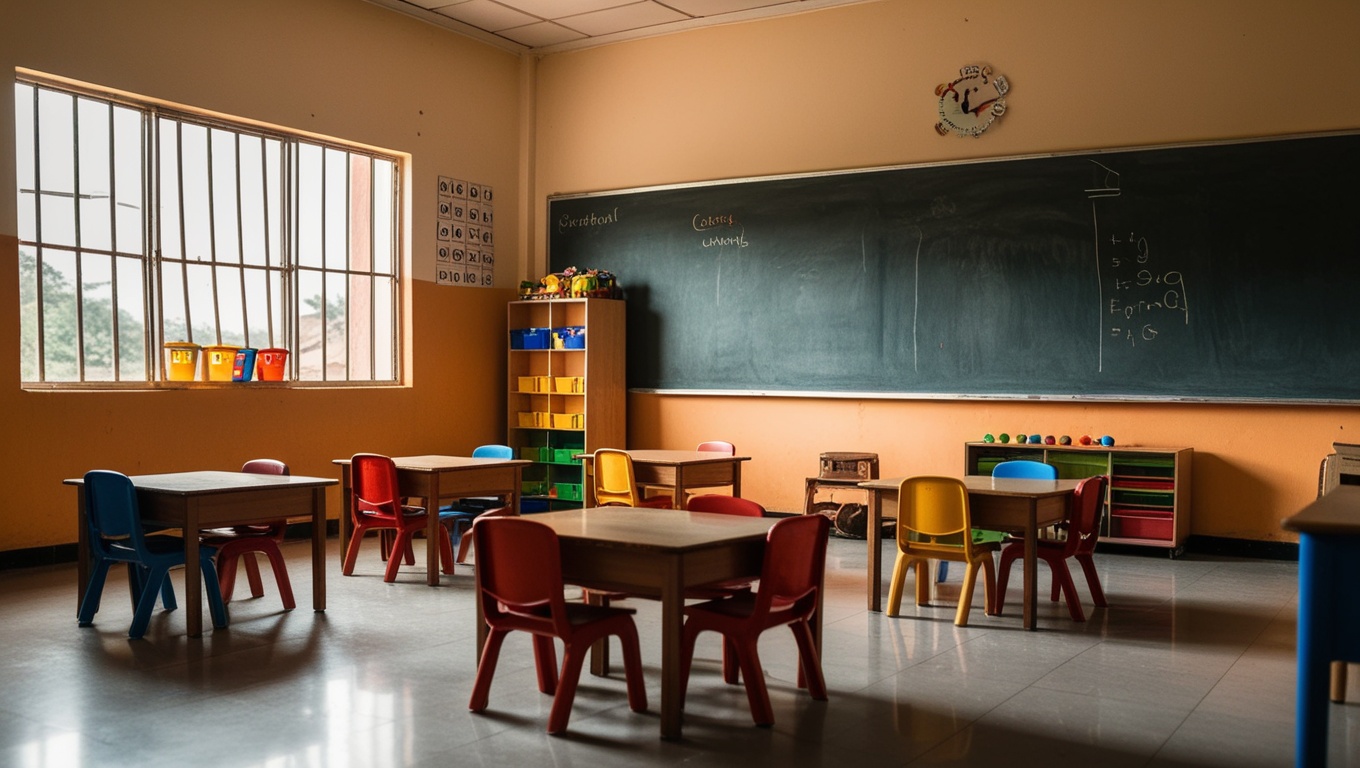
It is the most profitable educational investment known, and it is the one West Africa neglects the most. The work of Nobel laureate James Heckman establishes that a quality early-childhood programme returns 13% per child per year, over an entire lifetime, in the form of better health, better school results and higher future earnings. Yet in Benin, barely one child in four crosses the threshold of a pre-primary facility, and that proportion has not moved since 2016. Pre-primary is not an optional refinement reserved for mature education systems: it is the first link in the chain of learning, the one that determines all the others. To miss it is to send every cohort into primary school with a handicap that will be paid for throughout their schooling, and well beyond.
A region split into two worlds
West Africa does not suffer a uniform lag: it is home to two opposing realities. At one extreme, Ghana has made pre-primary a near-universal cycle, with a gross enrolment ratio of 116% (children older or younger than the official age band inflating the indicator beyond 100%) and 89% attendance one year before primary. Togo follows closely, at 84%. At the other extreme, Burkina Faso (6.5% gross ratio), Niger and Mali (below 8%) leave more than nine children in ten outside any early-learning facility. Between the two, Benin occupies a fragile middle position: a 23.1% gross ratio, 59.9% attendance one year before primary, with no real progress since 2016.
What is striking about this ranking is that it does not follow a geography of wealth or climate. Neighbouring countries at comparable levels of development appear at both extremes. The pre-primary hierarchy therefore tells less a story of economic constraints than a story of political choices: the choice of whether or not to integrate pre-primary into the public education system. That is good news, because choices, unlike inevitabilities, can be revised.
Two ways of counting, one reality not to be confused
Before going further, a methodological caution is in order, because it conditions any serious reading of the file. Two data series coexist and measure different things. The gross enrolment ratio comes from administrative data (World Bank, UNESCO-UIS) and relates all those enrolled, whatever their age, to the population of the official age band: it is the one that can exceed 100%, as in Ghana. Attendance one year before primary, by contrast, comes from household surveys (MICS, DHS) and measures the actual participation of children at the right age. These two indicators sometimes diverge sharply and never add up: Ghana's gross ratio exceeds 116% while its attendance plateaus at 89%.
This distinction is not a statistician's refinement. It determines what we believe we know. Using the gross ratio to steer equity would lead to misreadings; relying on attendance drawn from surveys spaced several years apart risks working on data that is already old. Nigeria's figures illustrate the risk: their gross ratio drops from more than 40% before 2014 to 15-24% afterwards, a sign of a break in definition or coverage that rules out any reading of a long-term trend. Steering pre-primary therefore requires knowing at all times which measure one is looking at, and what it truly says.
What the averages hide: the social divide
A national rate is an average, and averages mask what matters most. Behind Benin's 59.9% lies a twofold divide, social first. Attendance one year before primary reaches 90.8% among the wealthiest 20% of families, but falls to 34.5% among the poorest 20%: a ratio of 2.6 to 1. In other words, Benin's pre-primary is already the norm for well-off children and remains the exception for poor children. The average rate of 60% describes a reality that exists for almost no one: it adds together an elite that is largely enrolled and a modest majority left aside.
This divide reaches its peak in Burkina Faso, where inequality of access is the most brutal in the sub-region. Only 6.4% of children in the poorest quintile attend a pre-primary facility one year before primary, against 66.2% of the richest. There, pre-primary is not a public service with imperfect access: it is a privilege reserved for a minority, from which poor families are almost entirely excluded. This early exclusion mortgages what follows: the child who has never held a pencil nor heard the language of school enters primary with a starting gap that, more often than not, will never be closed.
The second divide: town against countryside
On top of social inequality is layered a territorial divide, because pre-primary facilities follow the towns. In Benin, attendance one year before primary reaches 73.2% in urban areas but falls back to 52.2% in rural areas. The gap widens elsewhere: in Niger, it runs from 84% in town to 45.3% in the countryside; in Burkina Faso, from 55% to 13%. These two divides do not cancel out, they compound: the child who is poor and rural is penalised twice, and that is precisely the child the system leaves aside most systematically.
The national rate of 23% therefore masks a two-speed reality: an urban elite largely enrolled and a rural, poor majority almost entirely excluded. This is why an aggregate figure, useful for comparing countries with one another, says nothing about where to act within a country. Without fine measurement by wealth quintile and by area, public investment is aiming in the dark.
An average rate of 23% describes no one: it adds together an urban elite largely enrolled and a rural, poor majority almost entirely excluded from early learning.
Three locks, all of them releasable
Why does access remain so low and so unequal? Three locks combine, and none of them is inevitable.
- Supply and its financing. Where the state withdraws, the private sector steps in and charges for access. The private sector accounts for nearly 80% of pre-primary enrolments in Burkina Faso and 57% in Mali, which effectively excludes poor families. In Benin, the private sector accounts for 32%, a share still high enough to push access mechanically towards households able to pay.
- The quality of supervision. Opening a class is not enough if there is no one to teach in it properly. Fewer than one teacher in four is trained to national standards in Benin (24%), one in six in Burkina Faso (17.2%), one in five in Mali (19.6%). And in Mali, there are 159 children per single qualified teacher.
- Geography. The location of facilities follows the towns and well-off areas, leaving the countryside and poor neighbourhoods with no nearby provision. Territorial exclusion is not an accident: it is the direct consequence of a location policy that has not targeted the most deprived areas.
These three locks reinforce one another. When the state withdraws, the private sector settles where there is a solvent clientele, that is, in town and among well-off families; quality, in the absence of an enforced public standard, becomes an adjustment variable; and the poor countryside combines the absence of provision with the absence of supervision. Releasing a single lock without touching the others produces little effect: it is the triptych that must be activated together.
The weight of the private sector: when access has a price
The financing mechanism deserves a pause, because it is what locks equity in place. Pre-primary is the only level of education where, in several countries of the region, the private sector is in the majority. In Burkina Faso, 79.4% of enrolled children are in the private sector; in Mali, 56.6%; in Nigeria, 51.7%. But a private pre-primary, by construction, selects by wallet. It therefore largely explains why, in Burkina Faso, the rich child gains access six to ten times more often than the poor child: with the state almost absent, the service goes to those who can pay for it.
Benin, with 32.1% private provision, is not in the extreme situation of the Sahel, but the share remains enough to weigh on equity. Conversely, Niger shows only 13% private provision: a sign not of a generous system, but of a still embryonic pre-primary, where the public sector dominates for lack of any provision at all. The lesson is clear: universal pre-primary is not decreed, it is publicly financed, otherwise it remains a market reserved for solvent families.
The cost of inaction: a learning crisis foretold
Missed pre-primary does not go without consequence: it is paid for at primary, and beyond. The PASEC 2019 diagnostic, conducted in 14 French-speaking countries including Benin, Senegal and Côte d'Ivoire, is unequivocal: at the end of primary, only 48% of pupils reach the sufficient threshold in reading and 38% in mathematics. More than half of an age group therefore leaves primary without mastering the fundamentals. And PASEC explicitly identifies the pre-primary shortfall as one of the drivers of this crisis: pupils who went through pre-primary do better than the others.
The link is mechanical. The child who has not been awakened, socialised, familiarised with the language and codes of school arrives in the first year of primary with a starting gap. That gap, far from closing, tends to accumulate year after year, up to dropping out. Every un-enrolled cohort therefore enters primary with a handicap that will be paid for throughout schooling, then on the labour market. Not investing in pre-primary does not save money: it shifts the spending towards repetition, remediation and school failure, at a far higher cost.
The best-documented return in the world
If inaction is costly, investment, for its part, pays like no other. It is the most solidly established point in the whole economics of education. The work of Nobel laureate James Heckman, tracking children over several decades, estimates the return of a quality early-childhood programme (from birth to age 5) at 13% per child per year, over an entire lifetime. This return materialises everywhere at once: better school results, better health, higher future earnings, crime avoided. No other educational investment shows such a return, nor such robustness in the data.
The economic logic is therefore crystal clear, and yet counter-intuitive for many public budgets: the most profitable franc in the whole education system is the one spent earliest, even before primary. Postponing this spending in the name of the urgency of higher cycles means giving up the best investment to finance more expensive and less effective remediation. Pre-primary is not the last budget priority once everything else is financed: it is the first, by return.
The most profitable franc in the whole education system is the one spent earliest, even before primary. Pre-primary is not the last budget priority: it is the first.
Ten years of uneven progress: the proof by trajectories
The gap between countries is not fixed: it was built, over a decade of different policies. Togo offers the clearest demonstration. In 2012, it started lower than Benin (10.7% against 19% gross ratio). Ten years later, it has overtaken and stabilised around 29%, while Benin marked time, oscillating between 22 and 25%. Senegal progressed slowly but steadily, from 14 to 18%. Burkina Faso, for its part, remains stuck below 7%, with no visible take-off.
These trajectories say what matters: where access has progressed, it is the result of a sustained public effort over time, not of a demographic accident. Togo did not benefit from miraculous conditions; it made a choice and stuck to it. Benin, by contrast, did not regress for lack of means: it simply stopped progressing, letting its 2012 lead erode. Stagnation, too, is a choice.
Pre-primary, a statistical blind spot
A discreet obstacle aggravates all the others: pre-primary is steered blind. Reliable data on access and above all on equity does not come from administrative systems, often deficient at this level, but from household surveys (MICS, DHS) spaced several years apart. As a result, decision-makers work on snapshots that are already old, without knowing whether the situation has improved or deteriorated since the last reading. And reference years differ from one country to another (2017 for Togo and Niger, 2024 for Mali), which further complicates regional comparisons.
This blindness has a concrete cost. Without fine and recent measurement, it is impossible to know where exclusion is concentrated, which rural areas to target as a priority, or whether a programme has really reduced the rich-poor gap. Resources are distributed without knowing whether they reach the children furthest from school. Pre-primary thus suffers from a double lag: of coverage first, of measurement second, and the latter sustains the former.
This is precisely where CRAD's contribution lies. The firm helps West African states and funders finely measure access to, and the quality of, pre-primary by wealth quintile and by area of residence, geolocate the poor rural zones where exclusion is concentrated, and evaluate the real return of early-childhood programmes. Digital field data collection, coupled with monitoring and evaluation, makes it possible to tighten the measurement cycle and break free from dependence on large surveys alone, spaced far apart. Measuring precisely where and for whom the pre-primary appointment is missed is the first condition for catching up.
The scale of the challenge, and its significance
The lag can be quantified without ambiguity. In sub-Saharan Africa, barely more than one pre-primary-age child in four (aged 3 to 5) is enrolled, about 27%, far below the global average. One year before primary, participation reaches about 49%, up by roughly 7 points since 2013, but still below the global mark of 75%. And in low-income countries, only one child in five has access to pre-primary, against more than half of children worldwide. The gap is not marginal: it is an entire continent starting the educational race a lap behind.
But this same quantification carries a promise. The roughly 7-point rise in regional participation over a decade proves that the trajectory can be bent. The objective is not out of reach: it requires a consistent policy, targeted at the children excluded today, that is, the poorest and the most rural. Closing the gap does not demand a miracle, but method and duration, exactly what distinguishes the Togolese and Beninese trajectories.
Fundamentally, West African pre-primary is not an unsolved pedagogical problem: we know perfectly well how to awaken a young child and what it brings them for life. It is a problem of political priority and of steering by data. The countries that progress are those that have decided to make pre-primary a public cycle, targeted at the excluded, and to measure their results where they play out: by quintile and by territory. Those that stagnate do not lack solutions, they lack a decision and a compass.
Key takeaways
- West Africa is split in two: Ghana (89%) and Togo (84%) enrol almost all their children one year before primary, while Burkina Faso (22%), Niger and Mali leave the majority out; Benin has stagnated at 60% since 2016.
- The average masks a twofold divide: in Benin, 90.8% of rich children access pre-primary against 34.5% of the poor, and 73% in town against 52% in the countryside; in Burkina Faso, the rich-poor gap runs from 66% to 6.4%.
- Three locks compound: a private sector that charges for access (up to 79% of enrolments in Burkina Faso), deficient supervision (fewer than one teacher in four trained in Benin, 159 children per qualified teacher in Mali) and a location modelled on the towns.
- Pre-primary is the most profitable educational investment known (13% per year per child, Heckman); its absence fuels the learning crisis (only 48% of pupils master reading and 38% mathematics at the end of primary, PASEC 2019).
- Pre-primary is a statistical blind spot: reliable data comes from spaced household surveys, not from administrative systems, which makes steering blind and calls for disaggregated and regular measurement.
Recommendations for West African decision-makers
- Make pre-primary a financed public cycle, not a private market: on the Ghanaian model, develop free or heavily subsidised public provision to break the link between family income and access to early learning.
- Explicitly target the children excluded today, that is, the poorest 20% and rural areas, by locating new facilities where exclusion is concentrated rather than where solvent demand already exists.
- Invest massively in the training of pre-primary teachers, with no country in the region reaching a third of trained teachers, and bring supervision ratios back to levels compatible with quality early learning.
- Set a national target for coverage and equity (by wealth quintile and by area) and monitor it each year through a public, enforceable indicator, to escape stagnation by default of steering.
- Shorten the measurement cycle by coupling household surveys with geolocated digital field data collection, in order to have recent, disaggregated and mapped data, the condition for effective targeting of investments.
- Treat pre-primary as the first budget priority in education, not the last: at a return of 13% per year, every franc spent before primary avoids far higher remediation spending downstream.
Sources
- World Bank, Data, School enrollment preprimary (% gross), SE.PRE.ENRR
- World Bank, Trained teachers in preprimary education (% of total teachers), SE.PRE.ENRL.TC.ZS
- UNESCO Institute for Statistics (UIS), Data Browser (NARA.AGM1, ETOIP.02.PR, PTRHC.02.TRAINED)
- UNESCO, Global Education Monitoring Report, Monitoring SDG 4 (2024)
- GEM Report SCOPE, Access to education
- World Bank, Early Childhood Development (theme)
- The Heckman Equation, Lifecycle Benefits of an Influential Early Childhood Program (13% ROI)
- CONFEMEN, PASEC2019, Quality of education systems in French-speaking sub-Saharan Africa
- UN, The Sustainable Development Goals Report 2024, Goal 4 (extended report)
- UNESCO-UIS, SDG 4 Country Profiles (Benin, Senegal, Nigeria)