Urbanisation: West Africa's tipping point and its blind spots
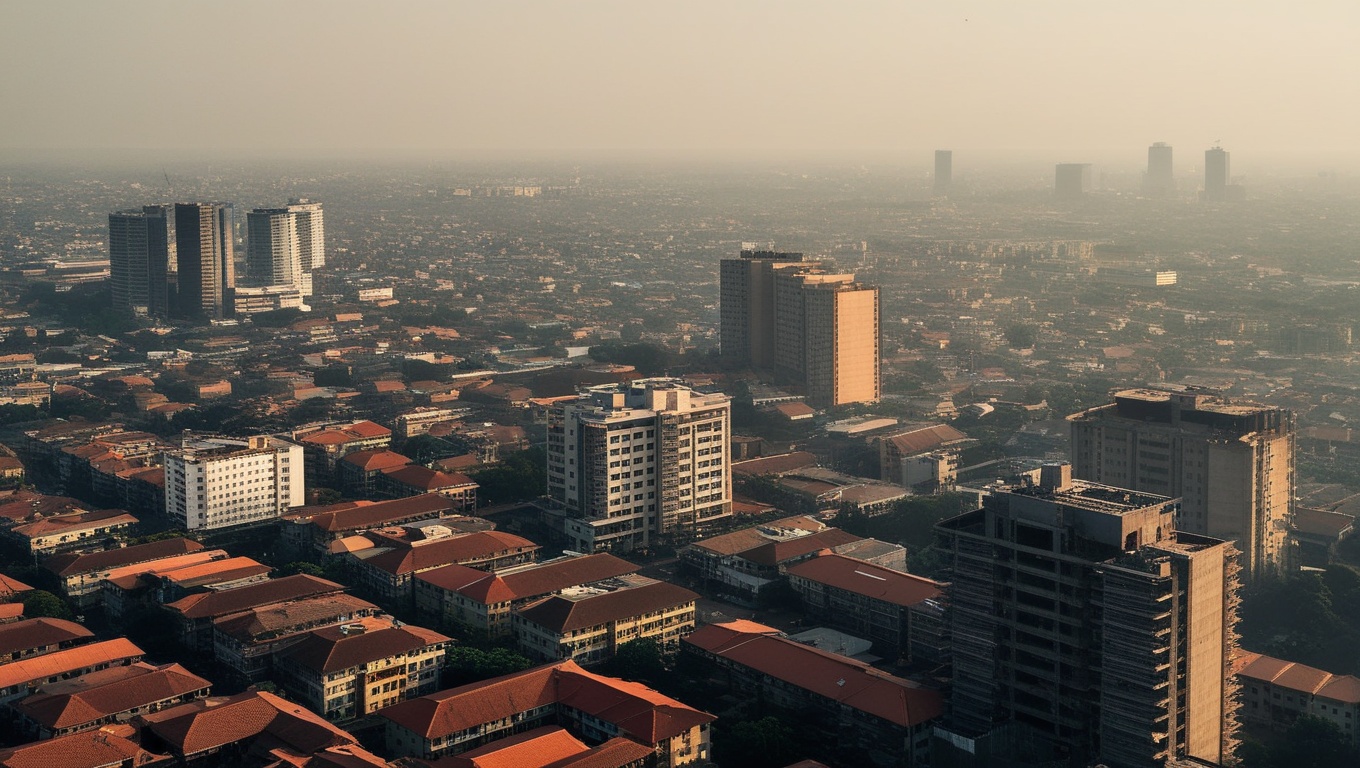
West Africa has crossed a historic threshold almost without noticing. Nigeria, the continent's most populous country, is now majority urban: 62.2% of its population lived in cities in 2023, compared with just 43.3% in 2000. This shift is no demographic footnote. It redefines where people live, how they fall ill and what states must fund as a priority. For behind the promised city, the one of jobs, hospitals and schools, another city is being built, informal and poorly served: in Mali, 92.5% of city dwellers already live in substandard housing. The question is no longer whether West Africa is urbanising, that is settled and irreversible, but whether it is preparing liveable cities or letting demography manufacture, neighbourhood after neighbourhood, a public-health time bomb.
A silent but irreversible shift
The change is first read in the long run. In Sub-Saharan Africa, the urban share of the population rose from 14.3% in 1960 to 43.6% in 2023, a tripling in two generations. Nigeria did even better, crossing the majority-urban mark around 2010 to reach 62.2% in 2023. Globally, 45% of the population, out of 8.2 billion people, lived in cities in 2025, more than double the share of 1950. West Africa is therefore no exception to a planetary movement; it is catching up at a forced pace, a generation behind and at a far faster rhythm. It is precisely this speed that poses the problem, because it leaves cities little time to equip neighbourhoods before residents pour into them.
One region, sharply contrasting trajectories
Speaking of the urbanisation of «West Africa» in the singular betrays reality. The region is in fact home to two worlds. On one side, societies already majority urban: Nigeria (62.2%), Ghana (57.8%), Senegal (54.7%), Côte d'Ivoire (53.4%) and, recently, Benin (51.8%). On the other, countries still predominantly rural: Togo (43.3%), Mali (31.0%), Burkina Faso (27.8%) and above all Niger, the least urbanised in the sub-region with only 17.8% city dwellers in 2023. This wide gap, nearly 45 points between Nigeria and Niger, means the challenges are not the same across countries: here, managing already-saturated metropolises; there, anticipating an urbanisation that has not yet happened but is arriving at great speed.
The engine: one of the fastest urban growth rates in the world
The shift is driven by dizzying growth rates. In 2024, the urban population was growing by 2.84% per year in Ghana, but by 4.20% in Burkina Faso, 4.87% in Mali and up to 4.95% in Niger, the fastest rate in the sub-region. At nearly 5% per year, a city population doubles roughly every fourteen years. In other words, Niger, today the least urbanised country, will have to house, treat and feed twice as many city dwellers by the mid-2030s as it counts today. This paradox is crucial: the least urbanised countries are often those whose cities are growing fastest, hence those with the least time to prepare and, very often, the most limited means to do so.
Two forces feed this engine. The first is a still-high birth rate, which mechanically swells the population of existing cities. The second is rural exodus, which moves toward urban centres populations in search of jobs and services. The cumulative result is spectacular: the OECD and its Sahel and West Africa Club project that the West African population will rise from 400 million in 2020 to 540 million in 2030, and that two thirds of this increase will occur in cities. That means nearly 100 million additional city dwellers to absorb in a decade, the equivalent of a new large metropolis every year.
At nearly 5% growth per year, Niger's urban population doubles every fourteen years. The question is not whether the city arrives, but whether water and sanitation networks will arrive before it.
When infrastructure fails to keep up: the informal city
When demography moves faster than public investment, the city does not stop being built: it is built without a plan, without title and without networks. The figures on substandard housing, measured by UN-Habitat as the share of city dwellers living in slums or inadequate dwellings, leave no room for doubt. In Mali, 92.5% of city dwellers are affected, the highest proportion among the reference countries, followed by Burkina Faso (87.9%) and Niger (70.4%). But the phenomenon is not confined to the Sahelian countries: in Benin, 64.0% of city dwellers live in substandard housing, a major gap with the recent crossing of the 50% urbanisation threshold. The Beninese city has therefore largely been built informally even before becoming majority urban.
The decisive blind spot: basic services and health
Substandard housing is only the visible facade of a graver deficit: that of basic services, and first among them sanitation. This is where urbanisation ceases to be a planning matter and becomes a first-order public-health issue. Basic urban sanitation covers only 31.1% of Benin's city dwellers and 34.6% of Ghana's, even though these two countries are among the most urbanised in the region. The paradox is striking: crossing the majority-urban threshold in no way guarantees access to toilets and drainage networks. Senegal does better (70.1%), Nigeria follows (57.6%), but no reference country reaches universal coverage, and those at the bottom of the ranking are precisely countries where the city is already dominant.
The regional picture confirms the scale of the problem. In Sub-Saharan Africa, two city dwellers out of three lack access to safely managed sanitation, including 193 million people who still practise open defecation. This is not an abstract statistic: it is a direct driver of cholera, diarrhoea and infant mortality. The very density of the city, which concentrates populations, amplifies contagion when wastewater is not controlled. Urbanisation, supposed to bring residents closer to hospitals and health centres, can thus produce the opposite effect if it comes with a sanitation deficit: more crowding, more contamination, more avoidable disease burden.
The Benin gap: a regional textbook case
Benin alone sums up the West African paradox. The country has just tipped to the urban side, with 51.8% city dwellers in 2023 compared with 38.3% in 2000, a rapid rise within a generation. But this demographic success masks a glaring lag in urban quality of life: 64.0% of city dwellers in substandard housing, only 31.1% covered by basic sanitation, and 75.9% with access to basic drinking water, which still leaves one city dweller in four without safe water. The juxtaposition is telling: a country that has become majority urban where two city dwellers out of three live in substandard housing and where only one in three has basic sanitation. The Beninese city has therefore grown in numbers far faster than in facilities. This is the typical profile of an urbanisation endured rather than steered, where the symbolic 50% threshold was reached without the networks keeping up.
The comparison with Senegal illuminates the room for manoeuvre. The two countries had nearly identical urbanisation levels at the start of the 2000s (40.7% in Senegal, 38.3% in Benin) and followed the same slope until 2020, around 50%. Then Senegal accelerated, reaching 54.7% in 2023 versus 51.8% in Benin, and above all with markedly better urban sanitation (70.1% against 31.1%). Two neighbouring countries, two trajectories: the difference does not lie in the pace of urbanisation, which is comparable, but in the investment made in services. Urbanisation is not a uniform destiny; it is a transition that is steered more or less well.
What national averages hide
One final point, decisive for action: the national urbanisation rate is an average, and averages hide the essential. Ghana offers the perfect illustration: it posts the best urban access to basic drinking water in the sub-region, at 97.4% of city dwellers in 2022, but only 34.6% access to urban sanitation. Same country, same urbanisation rate, two opposing service realities depending on the domain considered. Relying on the urbanisation figure alone, or even on a single service indicator, leads to false diagnoses and poorly targeted policies.
The national average also masks another divide, probably the most important: that between the capital and secondary cities. It is in the latter, often absent from the statistical radar, that most of the coming West African urban growth will play out. An already-saturated capital and a secondary city undergoing a population explosion call neither for the same investments nor for the same sequence of action, yet both disappear behind a single national percentage. Steering urbanisation from the country average alone is like navigating with a map that shows only the outline of the continent, without the coastlines or the ports.
- The divide by domain. A country can excel on one service and fail on another: Ghana reaches 97.4% urban water access but falls to 34.6% for sanitation. Tracking a single indicator misleads the diagnosis.
- The capital / secondary-cities divide. Urban growth is increasingly concentrated in mid-sized cities, poorly documented, while policies and budgets remain centred on the metropolises.
- The intra-urban divide. Within a single city, the gap between a serviced neighbourhood and an informal one is abyssal; the urban average smooths over this inequality and renders invisible the pockets of precariousness where public health deteriorates most.
The CRAD angle: steering the city through fine-grained data
This is precisely where the effectiveness of an urban policy is decided. Steering a successful urban transition requires fine-grained subnational data, city by city and neighbourhood by neighbourhood, that aggregate averages do not provide. Knowing how many people live in a given informal neighbourhood, at what distance from the nearest safe water point, with what access to a health centre, that is the information that turns a political intention into targeted investment. The same sanitation budget does not produce the same health gain depending on whether it equips a dense, deprived neighbourhood or an already-served area.
CRAD designs and deploys the full chain, from the census of agglomerations and geolocated field collection through to decision-support dashboards, to equip states and funders facing the twin challenge of housing and basic services. Mapping deficits by neighbourhood means moving urban policy from national statistics to an operational roadmap, from intention to precision. In a region where the city population is set to gain nearly 100 million residents in a decade, this capacity for fine-grained measurement is not a methodological luxury: it is the condition for an urbanisation that heals instead of making people ill.
The cost of inaction: demography does not wait
Time is working against states. Each year of unanticipated urban growth is one more informal neighbourhood that takes hold, networks that will then have to be retrofitted at great expense rather than laid in advance, and a health burden that settles in for the long run. The calculation is implacable: equipping a neighbourhood before it densifies costs a fraction of what it costs to regularise it once built. At nearly 5% annual growth in the Sahelian countries and two thirds of the region's additional 140 million residents to be absorbed in cities by 2030, the window to act upstream is closing fast. The real cost is not that of investing today in water, sanitation and housing, but that of not doing so: it will be paid tomorrow in avoidable epidemics, infant mortality and ungovernable cities.
A note of methodological caution is nonetheless in order. Population estimates for large cities diverge sharply depending on the definition adopted, administrative boundaries, functional agglomeration or metropolitan area, and depending on the source. Lagos is thus estimated at between roughly 16.5 million residents for the city and more than 20 million for the metropolitan area, and the UN's 2025 revision of its urbanisation prospects, based on a satellite method, has moreover revised several African megacities downward. Likewise, the OECD and its Africapolis observatory place Africa at 54% urbanisation in 2020 on a morphological threshold, whereas the World Bank, on national definitions, records 42.2% for Sub-Saharan Africa the same year. These gaps do not contradict the trend, they complicate it, and are a reminder that an urban figure only makes sense when accompanied by its definition. That is one more reason to build measurement systems that are consistent and repeated over time.
Fundamentally, the West African urban shift is neither good nor bad news in itself: it is an unavoidable transition whose outcome depends entirely on how it is steered. The city can be the most powerful accelerator of development, bringing residents closer to jobs, care and school. It can also become a health and social trap if networks never reach the neighbourhoods that are springing up. Between these two trajectories, the difference does not lie in demographic fate, but in the capacity of states to see, measure and target where averages show nothing. The blind spots of urbanisation are not filled with slogans: they are filled with data, neighbourhood by neighbourhood.
Key takeaways
- The shift is settled: Nigeria is majority urban (62.2% in 2023) and Sub-Saharan Africa has tripled its urban share since 1960 (14.3% to 43.6%).
- Trajectories are sharply contrasting, from Nigeria (62.2%) to Niger (17.8%), and it is the least urbanised countries that are growing fastest (up to 4.95% per year in Niger).
- The city is built informally: 92.5% of Malian city dwellers and 64.0% of Beninese live in substandard housing, for lack of infrastructure keeping pace with demography.
- Urbanisation is a public-health issue: two Sub-Saharan city dwellers out of three lack safely managed sanitation, including 193 million practising open defecation.
- National averages mislead: Ghana reaches 97.4% urban water access but 34.6% for sanitation; real governance plays out city by city and neighbourhood by neighbourhood.
Recommendations for West African decision-makers
- Anticipate rather than regularise: equip urban expansion zones with water, sanitation and roads before they densify, at a cost far lower than retrofitting an already-built neighbourhood.
- Make urban sanitation a public-health priority, on par with access to care, to cut off at the root the waterborne diseases that density amplifies (cholera, diarrhoea, infant mortality).
- Prioritise the fastest-growing countries and cities (Niger, Mali, Burkina Faso at nearly 5% per year), where the window to act upstream is closing fastest.
- Shift attention and budgets toward secondary cities, where most of the coming urban growth will concentrate, rather than on already-saturated capitals alone.
- Build subnational urban data systems (census of agglomerations, geolocated collection, neighbourhood mapping) to target investment where the service deficit is highest.
- Harmonise and maintain definitions and measurements over time, in order to compare cities reliably and move beyond the contradictory figures that today cloud governance.
Sources
- World Bank, Urban population share (SP.URB.TOTL.IN.ZS)
- World Bank, Urban population growth (SP.URB.GROW)
- World Bank, Slum / substandard housing population (EN.POP.SLUM.UR.ZS)
- World Bank, Urban access to basic drinking water (SH.H2O.BASW.UR.ZS)
- World Bank, Urban access to basic sanitation (SH.STA.BASS.UR.ZS)
- UN DESA, World Urbanization Prospects 2025 (Summary of Results)
- UN DESA, World Urbanization Prospects (Population Division portal)
- OECD/SWAC, Africa's Urbanisation Dynamics 2020 (Africapolis)
- OECD/SWAC, Africapolis data platform
- WHO/UNICEF JMP, Progress on Sanitation and Hygiene in Africa 2000-2022
- WHO/UNICEF JMP, Progress on household drinking water, sanitation and hygiene 2000-2022