HIV/AIDS in West Africa: a response left to consolidate
West Africa has won a battle that few believed could be won. Across the region's nine reference countries, new HIV infections fell from 233,800 per year in 2000 to 59,480 in 2024, a 75% decline, while AIDS-related deaths dropped by 60% since 2010 across West and Central Africa. This progress is no accident: it is the fruit of targeted testing, prevention of mother-to-child transmission, and putting millions of people on treatment. But this gain has a structural flaw: it rests almost 90% on external funding, and that funding is withdrawing. In 2025, the freeze on American aid already caused a 29% drop in antiretroviral coverage among HIV-positive pregnant women in Ghana. The question is no longer whether West Africa can drive HIV back, it has proven it can, but whether it can protect two decades of progress once the source of its funding runs dry.
A historic decline, but a victory still incomplete
Let us begin by measuring the distance travelled, because it is spectacular. According to UNAIDS estimates cited by the World Bank, the region's nine reference countries (Benin, Ghana, Senegal, Nigeria, Niger, Côte d'Ivoire, Mali, Burkina Faso, Togo) saw their annual new infections fall from 233,800 in 2000 to 59,480 in 2024. That is a reduction by nearly four in a single generation. Globally, the trend is of the same order: 1.3 million new infections in 2024, the lowest level since the late 1980s, down 40% since 2010. West Africa is therefore outperforming the global average, proof that its strategies have delivered.
Mortality tells the same story of progress. In 2024, AIDS-related deaths in West and Central Africa are estimated at 124,000, a 60% decline compared with 2010. Behind these figures lies a concrete reality: hundreds of thousands of lives preserved each year through access to antiretrovirals, a medicine that has turned a deadly disease into a manageable chronic condition. The West African response is, in this respect, one of the most effective public health policies ever deployed in the region.
But the victory remains incomplete. The care cascade, the indicator that tracks a person's journey from diagnosis to viral suppression, shows this plainly. In 2024, the regional cascade stands at 81-76-70: 81% of people living with HIV know their status, 76% are on treatment, 70% have a suppressed viral load. This is still far from the international target of 95-95-95, and it is the treatment link (76%) that remains the weakest. In other words, one person in four living with HIV in the region is still not being treated. Compared with more advanced Southern Africa, West Africa retains a gap that it was precisely in the process of closing.
A concentrated epidemic, not a generalised one: the key to the strategy
To understand why the West African response has been effective, one must grasp a decisive feature: the epidemic there is concentrated, not generalised. In 2024, 64% of new infections occur among so-called key populations, their clients and their partners. This radically changes the nature of the response: where a generalised epidemic requires reaching the entire population, a concentrated epidemic is fought by precisely targeting the most exposed groups. This is more efficient, but also more demanding, because it requires knowing exactly who to reach and where.
This characteristic explains the central role of data in the response. Well-targeted testing, prevention tailored to key populations, tracking of active patient files: each of these levers only works if a fine-grained mapping of the epidemic is available. The West African success is not merely a story of available medicines, it is a story of successful targeting, made possible by epidemiological surveillance and field surveys. This is a point CRAD knows intimately, since the fine measurement of hard-to-reach populations is at the heart of its work.
In a concentrated epidemic, every euro invested counts only if it reaches the right person. Data is not an add-on to the response, it is its precondition.
What the regional average conceals: nine countries, nine realities
The regional average, like any average, masks what matters most. Behind the aggregate figure lie considerable gaps between countries, which rule out any uniform steering. Prevalence among 15-49 year-olds ranges from 0.2% in Niger to 1.7% in Côte d'Ivoire, a ratio of nearly 1 to 9. Togo, Ghana and Nigeria sit at the upper end of the scale, while Senegal, Burkina Faso and Niger show very low prevalence. A single regional policy applied uniformly across these countries would be, depending on the case, oversized or insufficient.
But prevalence, expressed as a percentage, does not tell the whole story of the real burden, which also depends on population size. In absolute numbers, one country dominates all the others: Nigeria alone concentrates 2 million people living with HIV, or more than a third of the 5.2 million in the West and Central Africa region, more than all the other reference countries combined. Far behind follow Côte d'Ivoire (410,000) and Ghana (330,000), while Benin (70,000), Senegal (48,000) and Niger (32,000) are among the most modest burdens. This concentration carries a major strategic consequence: the security of the regional response depends on a single country. A decline in coverage in Nigeria would be enough to tip the indicators of all of West Africa, regardless of the progress made elsewhere.
The most consequential disparity, however, remains that of treatment coverage. It is what ultimately decides the number of lives saved. And it varies twofold: from 47% in Ghana to 92% in Togo. Ghana here presents a worrying paradox, that of a country with high prevalence (1.5%) but the lowest antiretroviral coverage of the nine, which makes it a major point of vulnerability for the region, even before the funding crisis.
The Achilles heel: a response funded from outside
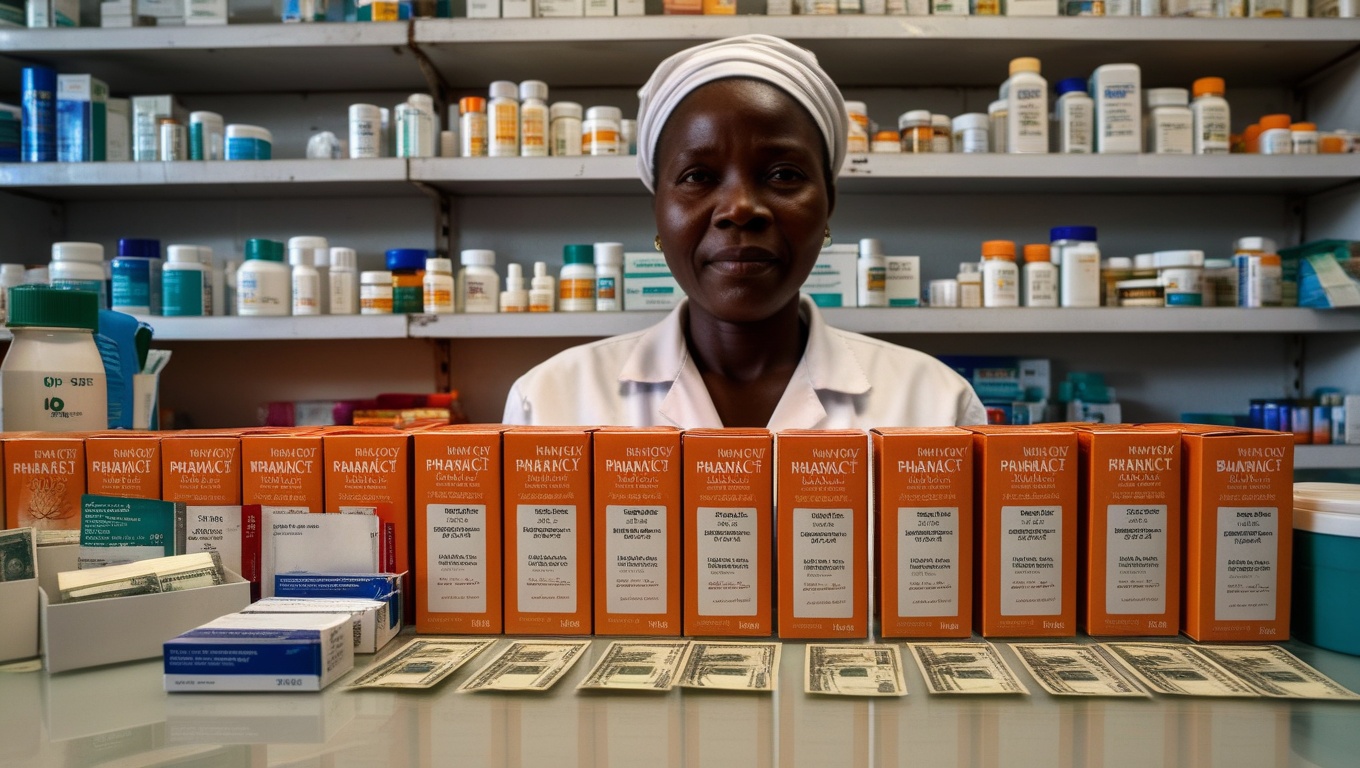
We now come to the heart of the problem. All the progress described so far shares a single fragility: it rests on international funding. In West and Central Africa, donors cover 90% of the cost of antiretroviral medicines and 100% of targeted testing of key populations. Almost the entire chain of services that drove the epidemic back therefore depends on the outside: states have steered the response, but they have not funded it.
This dependence was bearable as long as funding remained stable. It no longer is. The freeze on American aid decided in 2025 has drawn the region into a zone of unprecedented turbulence. What was a strength, the massive mobilisation of international resources over two decades, is today revealed as a systemic vulnerability. A model that depends 90% on an external source is, by construction, at the mercy of a decision taken elsewhere.
Concretely, it is the three chains of services that drove the epidemic back which rest on this external funding, and therefore three links that waver at the same time if aid withdraws:
- Targeted testing of key populations. Funded 100% by donors, it is the entry point of the entire response: without diagnosis, neither treatment nor prevention can follow. It is the first link exposed to the withdrawal of aid.
- Antiretroviral treatment. Donors cover 90% of the cost of the molecules that keep 76% of HIV-positive people alive and non-contagious. Any supply rupture translates into treatment interruptions, hence into deaths and a resumption of transmission.
- Prevention of mother-to-child transmission. It protects newborns from an avoidable contamination; it is precisely this link that already gave way in Ghana in 2025, with a 29% drop in coverage of HIV-positive pregnant women.
The cost of inaction: when the figures begin to reverse
The threat is not theoretical, it has already begun to materialise. In the first half of 2025, following the freeze on American aid, antiretroviral coverage of pregnant women living with HIV fell by 29% in Ghana. Yet this figure is not one indicator among others: every HIV-positive pregnant woman deprived of treatment is a risk of transmitting the virus to her child, a mother-to-child transmission that twenty years of efforts had precisely driven back. We are witnessing, in real time, the beginning of a regression.
Medium-term projections confirm the gravity of the stakes. A modelling study published in Lancet HIV estimates, in a realistic scenario, up to 74,000 additional AIDS-related deaths by 2030 in the event of a lasting cut in American funding, across seven sub-Saharan African countries. At the continental scale, extended scenarios point to several million additional deaths. These figures must be handled with caution, since they depend on assumptions and the available studies cover East and Southern Africa, not West Africa. But the order of magnitude is unambiguous: a lasting interruption would cost tens of thousands of lives.
The mechanism is relentless, and this is what makes HIV particular. Unlike other diseases, every treatment interruption produces a double effect: it threatens the life of the person concerned, and it revives transmission, because an unsuppressed viral load becomes contagious again. A patient who drops off treatment is therefore not only a patient in danger, but a potential new vector of the epidemic. Progress in testing, treatment and prevention forms a chain: breaking one link is enough to reactivate the whole. This is why the cost of inaction is measured not in deferred care, but in a reignited epidemic.
The burden in lives: where the epidemic still kills
To grasp the scale of what is at stake, one must look at where the epidemic still kills. AIDS-related deaths remain highly concentrated geographically. Nigeria alone records 42,000 deaths per year, followed at a distance by Ghana (13,000) and Côte d'Ivoire (8,400). These three countries concentrate the bulk of regional mortality. Benin, with 1,300 annual deaths, sits in the lower range. This map of mortality largely overlaps with that of fragilities: Ghana, with high prevalence and low coverage, already pays a heavy toll, and is among the countries where the withdrawal of donors is felt most harshly.
The dynamics of new infections: prevention on the front line
If mortality measures the failures of treatment, new infections measure the effectiveness of prevention. And it is this front that is most directly threatened by the withdrawal of funding, since donors cover 100% of targeted testing of key populations. In 2024, new infections remain concentrated in Nigeria (29,000) and Ghana (13,000), the two countries that already accumulate the most deaths. Benin, with 860 annual new infections, is among the lowest incidences in the region.
The economic logic here is beyond dispute. Testing and prevention cost a fraction of what a lifelong treatment costs, and they prevent contamination upstream. Cutting prevention funding today mechanically increases the treatment burden of tomorrow. This is the opposite of a saving: it is a deferral of cost, weighed down by human and budgetary interest. Every new infection avoided is an active patient file that does not lengthen, and therefore one less pressure on health systems already under strain.
Regional comparison: a gap that was in the process of closing
Placed in the continental context, the West African situation calls for a nuanced reading. The region has made remarkable progress, a reduction by nearly four in new infections and a 60% decline in deaths, but it remains behind Southern Africa, the historic epicentre of the epidemic yet also the region most advanced on the care cascade. The West African cascade of 2024 (81-76-70) remains far from the 95-95-95 target, and its weak link, treatment at 76%, is precisely the one that depends most on the funding now under threat.
The paradox is cruel. West Africa was engaged in a catch-up, methodically closing its gap with the more advanced regions. The withdrawal of donors comes at the worst moment, the one when the region needed to consolidate its recent gains rather than defend them. A victory that seemed secured becomes contested again, and the catch-up risks turning into a retreat.
The West African response is a reversible gain: two decades of progress rest on funding that nothing guarantees and on data that alone makes it possible to target accurately.
The CRAD angle: turning aid dependence into sovereign steering
The picture taking shape is not one of failure, but of a fragile gain that must be secured. And this securing rests on two requirements. The first is financial: gradually reducing dependence on volatile external resources by building sustainable national funding. The second is informational: in a concentrated epidemic, the effectiveness of each euro depends on the quality of targeting, hence on data. These two requirements are linked, because limited sovereign funding can only be effective if it is perfectly targeted.
It is precisely at this intersection that CRAD's work is situated. Epidemiological surveillance, surveys of key populations and monitoring-and-evaluation systems are not accessories to the response: they are the instruments that make it possible to know where the epidemic concentrates, which populations to reach, and whether interventions are producing their effects. Without disaggregated, geolocated and repeated data, a reduced national budget disperses without result. With it, that budget can concentrate its means where the return in lives saved is highest.
The stakes, in the end, are a change in the very nature of the response: moving from a response funded and instrumented from outside to a sovereign, national steering, supported by quality local data. This is the condition for the progress of two decades no longer to depend on a decision taken thousands of kilometres away. Protecting the gains of the West African response is not merely a matter of finding new funding, it is a matter of acquiring the means to deploy that funding with the precision a concentrated epidemic demands.
A final caution applies to the figures themselves. UNAIDS estimates come with wide uncertainty ranges: the regional total of 5.2 million people living with HIV falls within a band of 4.5 to 6.0 million, and projections of deaths linked to funding cuts vary strongly across scenarios. This uncertainty does not weaken the diagnosis, it reinforces it: it is a reminder that steering an epidemic requires continuous investment in measurement. One does not defend what one cannot measure, and one does not target accurately what one counts only approximately.
Key takeaways
- West Africa has cut its new infections by nearly four since 2000 (233,800 to 59,480 per year in the 9 reference countries) and reduced its AIDS-related deaths by 60% since 2010.
- The response remains vulnerable: international donors cover 90% of the cost of antiretrovirals and 100% of targeted testing of key populations in West and Central Africa.
- The withdrawal of American aid in 2025 has already caused a 29% drop in antiretroviral coverage of HIV-positive pregnant women in Ghana, the first signal of a regression.
- Regional averages mask major gaps: prevalence from 0.2% (Niger) to 1.7% (Côte d'Ivoire), antiretroviral coverage from 47% (Ghana) to 92% (Togo), and a Nigeria that concentrates 2 million people living with HIV and 42,000 deaths per year.
- With the epidemic being concentrated (64% of new infections among key populations, their clients and partners), the effectiveness of the response depends entirely on the quality of targeting, hence on data.
Recommendations for West African decision-makers
- Build a sovereign funding plan for the HIV response, on a multi-year horizon, to gradually reduce dependence on donors (today 90% of the cost of antiretrovirals) and secure the continuity of treatment in the event of an external shock.
- Steer the response country by country, not at the regional scale: with prevalence varying from 0.2% to 1.7% and coverage from 47% to 92%, each state must size its priorities to its own epidemiological reality.
- Ring-fence as a priority the testing and prevention of key populations (source of 64% of new infections), funded 100% by donors and therefore the most exposed to withdrawal, since every infection avoided spares a lifelong treatment.
- Urgently target the breaking points, starting with Ghana's antiretroviral coverage (47%) and the protection of HIV-positive pregnant women, to halt the regression already measured and prevent mother-to-child transmission.
- Invest in epidemiological surveillance, surveys of key populations and monitoring-and-evaluation systems, the only way to concentrate constrained budgets where the return in lives saved is highest.
- Track the 95-95-95 cascade each year through a public, enforceable indicator, prioritising the treatment link (76% today), in order to turn an international target into a measurable national roadmap.
Sources
- World Bank, HIV prevalence ages 15-49 (SH.DYN.AIDS.ZS)
- World Bank, People living with HIV (SH.HIV.TOTL)
- World Bank, Antiretroviral therapy coverage (SH.HIV.ARTC.ZS)
- World Bank, New HIV infections (SH.HIV.INCD)
- UNAIDS, Fact Sheet 2025 (global and regional statistics)
- UNAIDS, Global AIDS Update 2025
- UNAIDS, Regional profile West and Central Africa (2024 data)
- UNAIDS, Impact of US funding cuts on the HIV response
- Health Policy Watch, UNAIDS: Funding Cuts Pose Perilous Risks (UNAIDS 2025 report)
- Lancet HIV / PMC, Impact of the PEPFAR freeze on deaths and infections (modelling)
- The Global Fund, Nigeria profile (funding)
- The Global Fund, Côte d'Ivoire grants 2024-2026