Electricity Access in West Africa: The Urban-Rural Divide
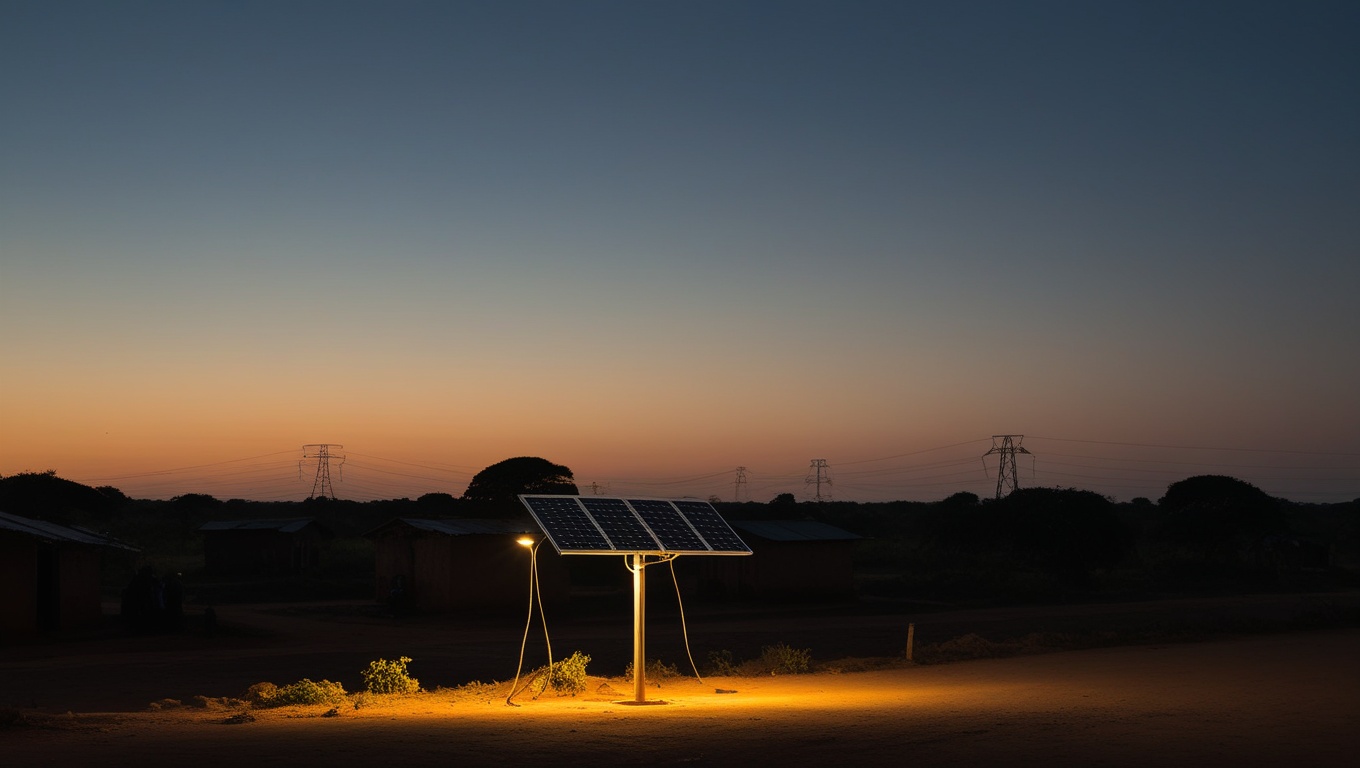
A household in Cotonou flips on the light without a second thought; a few dozen kilometres away, a village waits for nightfall with a kerosene lamp. This scene, ordinary in West Africa, reflects a failure of measurement as much as a failure of infrastructure. The electrification debate too often boils down to a ranking of countries, from Ghana (89.5 percent access) to Niger (20.1 percent). Yet the structural challenge lies elsewhere: in the divide separating cities from the countryside. As long as rural areas remain stuck between 10 and 44 percent access while cities exceed 67 to 98 percent, the universal access targeted for 2030 will stay out of reach. This gap is not a statistical nuance; it is the heart of the problem, and it calls for a different way of counting.
A Misleading Regional Ranking
Seen from afar, West Africa presents a contrasted but legible picture. At the top, Ghana posted the region's highest access rate in 2023, at 89.5 percent of the population. It is followed by Senegal (74.2 percent) and Côte d'Ivoire (72.4 percent), above the regional average. Nigeria (61.2 percent), Togo (59.2 percent) and Benin (57 percent) form an intermediate group alongside Mali (54.5 percent). At the other end, Burkina Faso (21.7 percent) and Niger (20.1 percent) remain at an almost embryonic stage of electrification. The ratio between first and last is more than four: at first glance, everything sets these countries apart.
This ranking shapes public action, and that is precisely the danger. It suggests that Niger and Burkina Faso have a problem of level, while Ghana has all but solved its own. The reality is more subtle: the national average is a statistical fiction that sums two worlds, the largely connected city and the countryside left behind. A country can climb the ranking by densifying its capitals without touching the rural deficit. Steering electrification by this single aggregate means committing to optimizing the wrong indicator.
The Real Divide Is Territorial, Not National
Behind every national average lies a geographic fracture. In Benin, 70.3 percent of city dwellers were connected in 2023, against only 43.7 percent in rural areas. Niger's case is even more striking: urban access reaches 67.4 percent, but rural access tops out at 10.4 percent, a 57-point gap. Even Ghana, exemplary with 97.5 percent urban access, retains a rural deficit at 77.8 percent. In other words, the region's best-ranked country still leaves more than one rural resident in five in the dark. The urban-rural gap is therefore not the symptom of a national lag: it is a signature common to the entire region, from the top performer to the last.
The finding holds at the regional scale. According to ECOWAS, about 42 percent of the region's population has access to electricity, but this rate falls to roughly 8 percent among rural residents alone. That figure frames the scale of the problem: this is not a residual deficit, it is a mass deficit. It is there, in the countryside, and not in the capitals, that universal access will be won. A policy that cannot distinguish the two populations will not know where to direct the effort either.
About 42 percent of West Africans have access to electricity, but barely 8 percent of rural residents. Universal access will not be won in the capitals, but in the villages.
The Fracture Is Not Inevitable: The Proof from Ghana
If the urban-rural gap were a natural law dictated by geography or poverty, all countries would line up on the same curve. They do not. The comparison between Ghana and Niger proves it: at comparable urban levels (97.5 percent against 67.4 percent), the two countries diverge radically on the rural side, 77.8 percent versus 10.4 percent. The city-countryside gap is only 19.7 points in Ghana, against 57 points in Niger. The difference does not lie in the nature of the countryside; it lies in the rural electrification policy pursued, or not, over two decades. Ghana made rural access an explicit, financed objective; the result is visible in the data.
This divergence is good news for public decision-making: it means the gap can be closed. Ghana did not wait until it was rich to electrify its villages; it made a choice of sequencing and financing that others can imitate. For Niger or Burkina Faso, the Ghanaian trajectory marks a credible target rather than a theoretical horizon.
The Last Mile: Why Rural Costs More
If the countryside lags behind, it is first a matter of infrastructure economics. According to ESMAP (World Bank), a connection by the national utility often exceeds 2,000 USD in rural areas, while a connection via solar mini-grid averages around 2,000 USD today but can fall to about 1,000 USD, or even less, on the best-optimized projects. Density changes everything: in the city, a kilometre of line serves hundreds of customers; in dispersed rural areas, the same kilometre serves a handful. The cost per connection explodes, revenue per customer collapses, and the public utility, already fragile, retreats. Three mechanisms combine to block the last mile.
- Dispersed settlement: low customer density per kilometre of line, so the connection cost per household is several times higher than in cities.
- Weak rural purchasing power: revenue per customer too low to amortize grid extension, which discourages centralized investment.
- The financing model: as long as the state mainly subsidizes large-grid extension, rural off-grid remains underfunded, even though it is the lowest-cost option per rural kilometre.
It is precisely this calculation that makes decentralized power the lever of the last mile. Off-grid solutions (mini-grids and solar kits) now represent a major share of new connections in Sub-Saharan Africa: solar home systems have contributed more than half of the access gains recorded on the continent in recent years. Mission 300, led by the World Bank and the African Development Bank to connect 300 million people by 2030, indeed counts on off-grid (mini-grids and solar home systems) for about half of new connections. Decentralized power is no longer a stopgap; it has become a key driver of rural electrification.
Real but Uneven Progress Over Time
The electrification effort has paid off where it has been sustained. Benin illustrates this momentum: the access rate rose from 29.6 percent in 2015 to 57 percent in 2023, nearly doubling in eight years. The curve shows a marked acceleration between 2021 and 2022 (from 42 to 56.5 percent), driven by connection programs, followed by a near-plateau in 2023. This staircase profile is instructive: rapid gains often come from urban and peri-urban densification, which is easier to deliver. The plateau that follows signals the moment the grid runs up against the dispersed countryside. Without a shift in model, the rural last mile will remain the hardest to cover.
At the continental scale, the urgency remains immense. Roughly 600 million people still lived without electricity in Sub-Saharan Africa in 2023, a figure almost identical to 2015 despite rising rates: population growth absorbs much of the new connections. The region now accounts for roughly four in five people without electricity worldwide. To meet the universal-access goal, more than 120 million people would need to gain access each year to 2030 worldwide, a pace far above what has been observed. The gap between the current trajectory and the target is not marginal; it is an order of magnitude.
The Cost of Inaction: What the Absence of Power Destroys
Failing to electrify is not a neutral status quo; it is an active loss, and it can be quantified. The energy deficit weighs directly on the economy: outages and the lack of a reliable grid are estimated to cost up to about 2.1 percent of GDP across Sub-Saharan Africa, and the sales of the region's firms would be about 4.9 percent lower than they would be with reliable supply. For the most exposed firms, losses tied to outages can reach as much as 31 percent of turnover. Every year without rural electricity is a year of economic activity cut short, of deferred investment and of jobs not created.
The human cost is just as heavy, and it concentrates exactly where national data see it least: in rural public services. In Sub-Saharan Africa, 15 percent of health facilities have no electricity access at all, and only about 40 percent have a reliable supply, with a clear rural disadvantage. Across low- and lower-middle-income countries, close to one billion people are served by health facilities with unreliable electricity or none at all. Without power there is no cold chain for vaccines, no lighting for night-time deliveries, no diagnostic equipment: the absence of electricity translates into measurable health risk.
What Averages Hide, and Why Fine Measurement Changes the Decision
Everything above comes down to one idea: the national average is the enemy of energy equity. A country can post 57 percent access and mask a rural rate of 44 percent and an urban rate of 70 percent. Worse, two countries with the same national rate can have opposite rural gaps. The average says neither where the unconnected are, nor how much their connection will cost, nor by which mode (grid or off-grid) it will be cheapest. Yet these are precisely the three questions a decision-maker must answer to allocate a budget. Steering universal access from a national aggregate is navigating without a map.
This is where disaggregated, geolocated measurement becomes an instrument of decision, not a mere statistical exercise. Surveying unserved populations locality by locality, geolocating schools and health centres without power, distinguishing the dispersed countryside from clustered rural settlements: these data change the nature of the trade-off. They make it possible to assign the centralized grid where density justifies it, and the solar mini-grid where it is unbeatable, instead of blindly extending the most politically visible line. This is precisely CRAD's craft: turning an average deficit into a map for action, from the field to the dashboard.
The national average says neither where the unconnected are, nor how much their connection will cost, nor by which mode it will be cheapest. Yet these are the only three questions that matter for a budget.
The Gender Angle: Electricity as a Lever for Equality
The urban-rural divide is compounded by a gender divide that aggregate statistics erase. In unelectrified rural areas, it is mostly women and girls who bear the burden of gathering wood and fuel, and who are most exposed to indoor air pollution from kerosene and biomass. The arrival of power frees up time and channels it toward school and economic activity: the available research documents a more pronounced rise in school enrolment for girls in newly electrified households, and an increase in female employment in connected communities. Electrifying the countryside is therefore not only about connecting homes; it acts on gender equality, maternal health and human capital. But these effects must be measured in a disaggregated way to be steered, rather than assumed.
Financing: A Real but Undersized Effort
Money remains the crux of the matter, and it is short. Despite 1.1 billion USD in IDA financing mobilized by the World Bank for electricity access, more than 220 million people in Western and Central Africa remain without access, nearly half the regional population. At the continental scale, reaching universal access by 2030 would require on the order of 22 billion USD per year, while current investment represents only a fraction of that. Mission 300 has mobilized nearly 50 billion USD in financing pledges from its partners (Dar es Salaam summit) and has already helped connect more than 50 million people (World Bank and AfDB announcement, June 2026); 48 countries endorsed the Dar es Salaam Energy Declaration in early 2025: the political will exists. The challenge is no longer only to mobilize funds, but to direct them where they genuinely narrow the gap, that is, toward the countryside, on the basis of reliable data rather than reassuring averages.
Key takeaways
- The decisive divide is territorial, not national: across ECOWAS, about 42 percent of the population has access to electricity but barely 8 percent of rural residents, and in Niger the countryside (10.4 percent) lags 57 points behind the city (67.4 percent).
- The fracture is not inevitable: at comparable urban levels, the city-countryside gap is only 19.7 points in Ghana versus 57 in Niger, proof that rural policy, not geography, makes the difference.
- Off-grid is winning economically: in rural areas a connection by the national utility often exceeds 2,000 USD (ESMAP), while the best solar mini-grids fall toward 1,000 USD per connection, and off-grid already represents a major share of new connections.
- Inaction is costly: outages and the grid deficit are estimated to cut up to about 2.1 percent of regional GDP, and 15 percent of the region's health facilities have no electricity at all, with a marked rural disadvantage.
- Financing remains undersized: despite 1.1 billion USD mobilized by the World Bank and nearly 50 billion USD in partner pledges to Mission 300 (which has already connected more than 50 million people), universal access requires on the order of 22 billion USD per year, far above the current pace.
Recommendations to West African decision-makers
- Steer electrification by the urban-rural gap indicator, not by the national average alone: set binding rural targets and disaggregated territorial monitoring to direct budgets toward the areas furthest behind.
- Build a geolocated map of unserved localities, schools and health centres, in order to assign the grid where density justifies it and the solar mini-grid where it is unbeatable, instead of blindly extending the most visible line.
- Make the solar mini-grid the default connection mode in rural areas, where its per-connection cost is lower than grid extension (which often exceeds 2,000 USD per rural household according to ESMAP), reserving the centralized grid for high-density zones.
- Prioritize the electrification of rural public services (health, schools) through decentralized solar, to turn the deficit into measurable health and education gains, especially for women and girls.
- Secure and structure decentralized financing: dedicated windows for off-grid operators, risk guarantees for public-private partnerships and tariffs suited to rural households, to channel Mission 300 and IDA funds toward the countryside.
- Coordinate at the regional (ECOWAS) level the sharing of models that work, from Ghana and Senegal toward Niger and Burkina Faso, so that the path to universal access by 2030 does not depend on national effort alone.
Sources
- World Bank, Access to electricity (% of population), EG.ELC.ACCS.ZS
- World Bank, Access to electricity, rural, EG.ELC.ACCS.RU.ZS
- World Bank, Access to electricity, urban, EG.ELC.ACCS.UR.ZS
- World Bank, Powering Up Western and Central Africa
- World Bank, Mission 300 (Energizing Africa)
- IEA, SDG7: Access to Electricity, Data and Projections
- IEA, Access to electricity improves slightly in 2023, but still far from the pace needed to meet SDG7
- ESMAP (World Bank), Mini Grids for Half a Billion People (2022), connection costs
- World Bank and AfDB, Mission 300 connects over 50 million people to electricity (press release, June 2026)
- WHO, Electricity in health-care facilities (fact sheet)
- Center for Global Development, Outages Cost Companies As Much as 31% in Sales
- Businessday NG, ECOWAS targets universal rural electrification by 2030
- Journal of Public and International Affairs (Princeton), Gendered Effects of Electrification in Sub-Saharan Africa
- French Treasury (DG Trésor), Energy Model for West Africa