Floods and disasters: the human cost of a destabilised climate
In 2024, a single rainy season was enough to cause 1,526 deaths, 4,499 injuries and nearly one million displaced people across eleven countries of West and Central Africa (OCHA, 31 October 2024). This toll is not an isolated accident: it is the accelerated version of an underlying trend. Over twenty years, the frequency of floods on the continent has jumped by 180 %, and the hazard that once seemed exceptional has become the norm of West African summers. A destabilised climate can no longer be read only in distant temperature curves: it is counted in deaths, in homes swept away and in flooded fields. And it is counted poorly, because disaster data in West Africa remains structurally incomplete.
Floods, the leading hazard of a continent tipping over
The shift is documented. Between 2002 and 2021, Africa recorded 793 floods against 137 droughts (EM-DAT / CRED). Together, these climate disasters account for more than half of the continent's natural disasters, and flooding is now their leading cause. The contrast with the previous period is striking: over 1982-2001, there were 283 floods; over 2002-2021, 793. That is an almost threefold increase in a single generation, whereas droughts rose by only 30 %.
This acceleration is not an impression, it is a measured trajectory. It means that the exposure of West African populations to floods is no longer a theoretical risk to prepare for, but an annual reality to manage. Yet the region's warning, evacuation and compensation systems were designed, where they exist at all, for a world in which flooding was rare. The gap between the actual frequency of the hazard and the capacity to respond is the first problem revealed by the figures.
Two faces of climate disruption: floods hit hard, droughts hit wide
Reducing the human cost of climate to floods alone would be a misreading. The figures describe two complementary hazards, almost symmetrical. Over 2002-2021, floods caused 14,053 deaths in Africa, droughts 20,821, that is nearly 35,000 combined deaths from these two climate phenomena alone. But it is on the side of affected people that the gap becomes staggering: drought affected around 295 million people, against 58 million for floods, five times more.
The meaning of these figures fits in a single sentence: flooding is the most frequent and most visible hazard, drought the most far-reaching and most silent. A flood carries away lives, homes and roads in a matter of hours; it makes the headlines, mobilises rescue teams and triggers emergency aid. Drought, by contrast, settles in over months, with no spectacular image, but it eats away at harvests, exhausts herds and pushes millions of people towards hunger and exodus. The first is a shock, the second an erosion. A serious climate policy cannot focus on one while neglecting the other.
2024, the year the Sahel was submerged
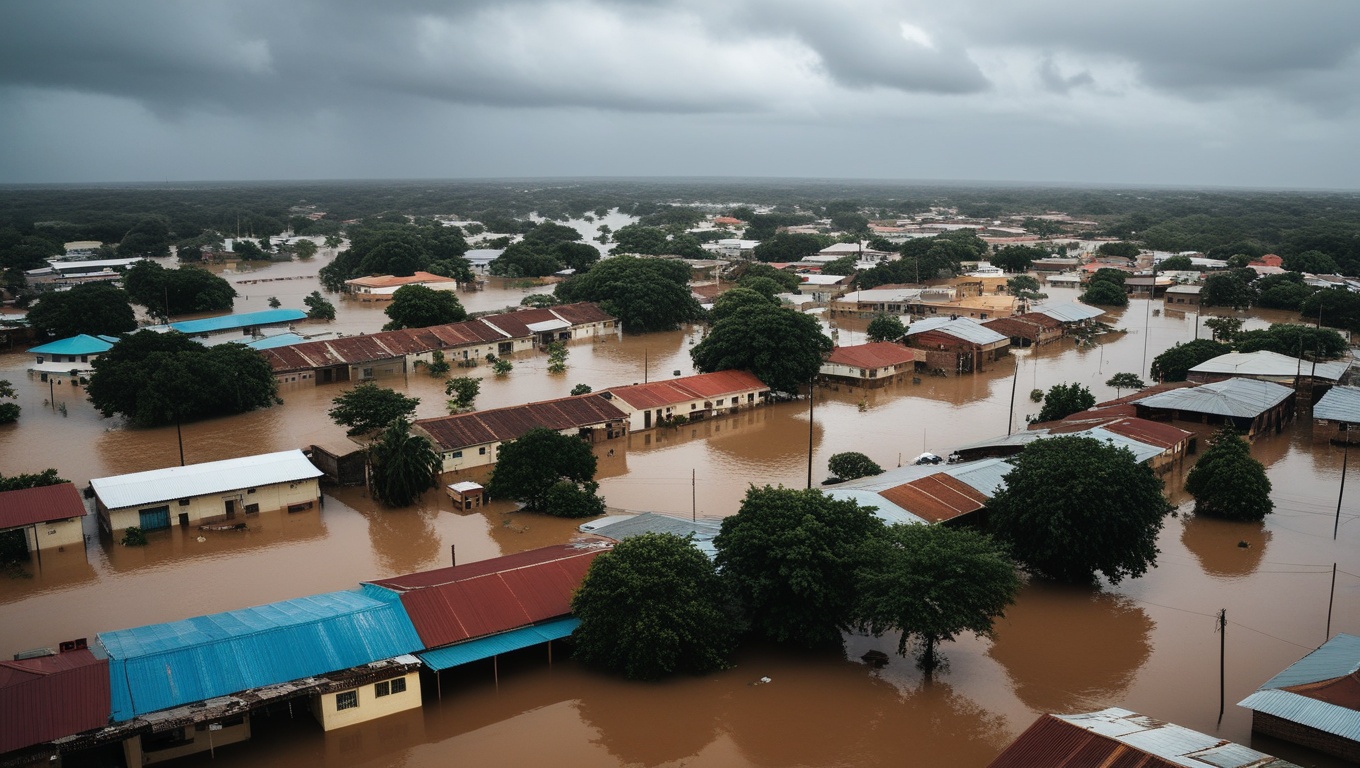
The year 2024 will remain a full-scale demonstration. As of 31 October, floods had caused, across eleven countries of West and Central Africa, 1,526 deaths, 4,499 injuries and displaced nearly one million people (OCHA). Mali, Niger and Nigeria experienced their worst floods in thirty years. Mali even recorded its most severe floods since the 1960s, with 343,900 people affected and at least 55 deaths (IRC). Whole countries, among the poorest and most fragile on the planet, saw their farming season and infrastructure wiped out at the same time.
The geographical concentration is striking. Chad (1.9 million affected), Niger (1.4 million), Nigeria (1.3 million) and the DR Congo (1.1 million) account for the bulk of the victims. The central Sahel, supposedly the driest region, found itself under water. This paradox is not one: a destabilised climate does not merely dry out, it also makes rainfall more violent and more concentrated, turning in a few days soils hardened by drought into surfaces unable to absorb water.
The rise of the toll over the course of the season illustrates another difficulty: a disaster is not an event, it is a process. The number of people affected rose from around 731,000 in mid-August to 2.3 million at the end of August, then to 6.9 million at the end of October. Deaths followed the same slope, from 250 to 465 then 1,526. Each figure is only true on the date it is cited, which has direct consequences for the way aid is calibrated and for how public opinion perceives the scale of the tragedy.
Nigeria, laboratory of a vulnerability that goes uncorrected
No country in the region better illustrates the repetition of shocks than Nigeria. In 2022, its floods, the worst since 2012, caused 662 deaths, 2,430,445 displaced and more than 4.4 million affected (NEMA). They made 174,000 homes uninhabitable and damaged more than 676,000 hectares of farmland, worsening the food insecurity of an already fragile country. These floods were not unpredictable: ten years on, they reproduced the 2012 scenario, including the aggravating role of releases from the Lagdo dam in Cameroon.
The comparison over time is instructive. The 2012 floods had affected 7 million people, those of 2022 around 4.4 million, those of 2024 around 1.3 million. The apparent decline in tolls should not mislead: it owes as much to the varying scale of rainfall as to prevention efforts, and 2012 remains a peak that is hard to compare with. What the series shows above all is that a country can suffer, in quick succession, several mass disasters without its structural vulnerability, urbanisation in flood-prone areas, under-investment in dykes and drainage, dependence on foreign dams, being corrected.
Behind the displaced people lie the 676,000 hectares of farmland flooded in 2022. This is the blind spot of human tolls: a flood does not only kill on the day it strikes, it prolongs the crisis into food insecurity for months after the waters recede. A lost harvest means empty granaries in the following dry season, soaring prices, families tipping over the edge. The human cost of a flood is paid long after the cameras have left.
The mechanisms: why West Africa pays so dearly
The human cost is not a geographical fate, it results from a combination of identifiable factors. The first is climatic: the central Sahel is warming around 50 % faster than the global average (IRC), which intensifies rainfall episodes. The second is human: unplanned urbanisation pushes populations to settle in flood-prone areas, on river floodplains or lowlands, without drainage. The third is infrastructural: the management of major dams, whose poorly coordinated water releases have worsened floods (Lagdo in Cameroon in 2022, Alau near Maiduguri in 2024), turns heavy rain into disaster.
These three mechanisms have one thing in common: they are, at least in part, controllable. Rain cannot be decided, but land-use planning, building zoning, cross-border coordination of dams and early-warning systems can be. The human cost sits very largely within this space of decision, between the natural hazard and the exposure organised by public choices. That is precisely what makes inaction costly and anticipation worthwhile.
A flood carries away in a few hours; drought eats away over months. One is a shock, the other an erosion. A country can now suffer both in the same year.
The cost of inaction: GDP points swallowed up every year
The price of these disasters can be quantified, and it is colossal. The 2012 floods in Nigeria caused 16.9 billion dollars in economic losses (GFDRR / World Bank), the equivalent of several years of investment budget for most neighbouring countries. At the continental scale, the World Meteorological Organization estimates that African countries lose 2 to 5 % of their GDP and that many divert up to 9 % of their public budget to respond to climate extremes.
This last figure deserves a pause. Diverting nearly a tenth of a national budget towards managing the climate emergency means that much less for schools, health or productive infrastructure. A disaster does not only destroy property on the day it strikes: it lastingly captures scarce public resources, sustaining a vicious circle in which the money that should fund development funds the repair of damage. Every franc spent on emergency response is a franc taken away from the prevention that would have avoided the next disaster.
The horizon is even more worrying. By 2030, up to 118 million people in extreme poverty will be exposed to droughts, floods and extreme heat in Africa, absent adaptation (WMO). This figure links the two ends of the problem: it is the poorest, the least insured, the least mobile, who pay the heaviest price to the climate. The human cost of climate disruption is not distributed at random, it falls first on those who contributed least to the problem and have the fewest means to cope with it.
What averages hide: the silent concentration of shocks
The big continental figures, useful as they are, hide the essential: a disaster is a concentrated phenomenon. In 2024, four countries accounted for almost all of the 6.9 million affected people in West and Central Africa. And within each country, it is a few regions that tip over: the states of Kogi and Benue in Nigeria in 2012, 27 municipalities out of 77 in Benin in 2022. A national average can remain reassuring while a specific territory is living through a total disaster.
Benin offers a clear illustration. In 2022, floods there caused 41 deaths, affected more than 73,000 people, hit 27 of the 77 municipalities and destroyed 18,770 hectares of crops (OCHA / Red Cross). These figures, modest at the continental scale, describe a major crisis for the communities concerned. Reasoning in averages risks allocating aid away from the real need, statistically smoothing out localised tragedies that demand a targeted response.
- Geographical concentration. A few countries, then a few regions within those countries, concentrate the bulk of the victims. The national average dilutes this reality and distorts the targeting of aid.
- The lag in time. A toll rises over weeks (from 731,000 to 6.9 million affected in 2024); without a date, a figure has no meaning and underestimates the tragedy.
- The agricultural shockwave. The flooded hectares (676,000 in Nigeria in 2022, 18,770 in Benin) prolong the disaster into food insecurity, well after the waters recede.
The CRAD angle: under-reported data distorts the whole response
Here is the crux of the problem, and it is as methodological as it is humanitarian. In West Africa, disaster data is structurally under-reported. Tolls vary from one source to another: on the 2022 floods in Nigeria, NEMA reports 662 deaths and 2,430,445 displaced (final official figures), whereas mid-October media coverage spoke of more than 600 deaths and 1.4 million displaced. The gap owes more to the timing of the count than to a substantive contradiction, but it illustrates how much the same event can produce very different figures depending on who counts, when and how.
The deep cause is well known: rural communities without civil registration or land registry escape the counts. One counts well only what has been registered beforehand. Where civil registration is patchy, where informal housing appears on no plan, where agricultural losses are only roughly estimated, the real toll of a disaster will always fall short of the truth. And this statistical invisibility is not neutral: it has direct consequences for people's lives.
Because under-reporting distorts the allocation of aid, which is already cruelly insufficient. In 2024, the humanitarian response plan for the Sahel was only 25 % funded at mid-point. When needs are underestimated because they are poorly measured, and when even the declared needs are covered only by a quarter, the financing gap is paid in lives. This is where the question of data ceases to be technical and becomes deeply political and human: counting accurately is the first condition for helping and financing fairly.
This is the conviction that guides CRAD's approach to climate risks. Disaster data only has value if it is harmonised across actors (national agencies, OCHA, NGOs), geolocated down to the municipality and repeated from one season to the next. Building harmonised and geolocated national collection systems is not a statistical luxury: it is the condition for a rapid response, fair financing and adaptation targeted where the risk is highest. Without this compass, the region will keep reacting blindly, season after season, to disasters whose scale it measures poorly.
One counts well only what has been registered beforehand. Where civil registration is missing, the real toll of a disaster will always fall short of the truth.
From diagnosis to decision: counting in order to protect
At its core, the human cost of climate disruption in West Africa is not only a matter of more violent rains or longer droughts. It is also, and perhaps first of all, a matter of measurement. A hazard that is poorly measured is a hazard that is not prevented, not financed and only repaired late. The countries that reduce their vulnerability will be those that invest not only in dykes and early warning, but in the very capacity to know, in real time and at the right geographical level, what is happening on their territory.
Data does not stop a flood and does not bring down the rain. But it decides how fast rescue arrives, how much aid will be mobilised, where a village will be rebuilt and who will be compensated. Facing a destabilised climate, quality statistics have become an instrument for protecting populations. That is where, very concretely, the difference between suffering and anticipating is decided.
Key takeaways
- Flooding has become Africa's leading hazard: 793 floods recorded over 2002-2021 against 137 droughts, with frequency up 180 % over twenty years (EM-DAT).
- Two complementary hazards: drought affected five times more people (295 million against 58 million) and killed more (20,821 deaths against 14,053) over 2002-2021.
- 2024 was a record year: 1,526 deaths and nearly 7 million affected across eleven countries; Mali, Niger and Nigeria experienced their worst floods in 30 years.
- The cost is massive: 16.9 billion USD in losses in Nigeria in 2012; 2 to 5 % of GDP lost and up to 9 % of public budgets diverted at the African scale (WMO).
- Disaster data is under-reported and aid under-funded (2024 Sahel plan funded at 25 %), which distorts the allocation of relief to the detriment of the poorest.
Recommendations for West African decision-makers
- Build national disaster data collection systems that are harmonised, geolocated down to the municipality and repeated each season, in order to end the under-reporting that distorts the response and the financing.
- Address the two major climate hazards jointly, the flood that hits hard and the drought that hits wide, rather than concentrating resources on the single most visible crisis.
- Invest in preventive adaptation (dykes, urban drainage, building zoning in flood-prone areas, early warning) rather than letting up to 9 % of public budgets be absorbed each year by emergency response.
- Coordinate the management of major dams at the cross-border scale, since their poorly synchronised releases (Lagdo, Alau) turn heavy rains into mass disasters.
- Systematise the assessment of agricultural losses after each flood (flooded hectares, lost harvests) to anticipate and finance the delayed food crisis that follows the receding of the waters.
- Strengthen and honour regional humanitarian response plans, whose chronic under-funding (25 % for the Sahel in 2024) is paid directly in lives, by prioritising populations in extreme poverty, the most exposed.
Sources
- EM-DAT / CRED, CRED Crunch n 69 (Dec. 2022): interplay drought-flood Africa 2002-2021
- PreventionWeb, CRED Crunch n 69 (summary)
- EM-DAT, international disaster database (CRED, UCLouvain)
- OCHA, West and Central Africa Flooding Situation Overview (31 Oct. 2024)
- OCHA, West and Central Africa Flooding Situation 2024 Overview (10 Feb. 2025)
- IRC, Record-breaking floods devastating Niger, Mali and Nigeria (Sept. 2024)
- NEMA via The Guardian Nigeria: more than 2 million displaced by the 2022 floods
- OCHA, Nigeria Floods Response Flash Update 2 (1 Nov. 2022)
- GFDRR / World Bank, Nigeria Post-Disaster Needs Assessment 2012 Floods
- Red Cross / IFRC, Benin Floods 2022 DREF Final Report (MDRBJ017)
- WMO, State of the Climate in Africa 2023: the cost of adaptation
- WHO Africa (WHO AFRO): West and Central Africa floods, more than 4 million affected