Rice imports: the cost of food dependency
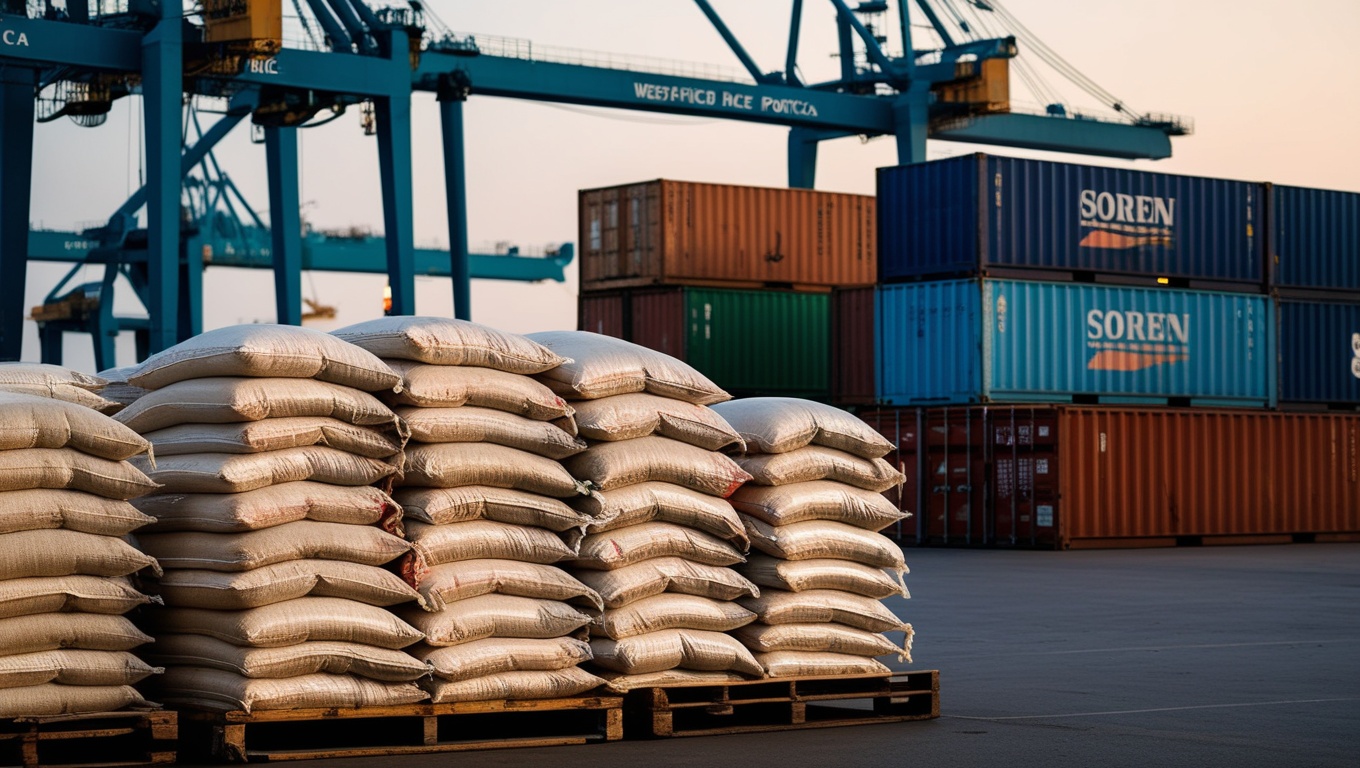
Every year West Africa harvests a little more rice, and buys a little more from abroad. The gesture looks harmless in the markets of Cotonou or Dakar, where the imported bag is often cheaper and more reliable than local rice. But added up across the region, it traces a dependency that exceeds 3.5 billion dollars a year and that, as cities swell, turns a household-basket issue into a question of budgetary sovereignty. The paradox is no agronomic fate: it rests on a gap of a few points between demand racing ahead and supply following too slowly. It is precisely that gap, and what it costs to let it widen, that deserves a close look.
A widening deficit despite production gains
Local production across the ECOWAS area today covers only about 60 % of regional demand. On paper, West Africa has every asset needed to secure its self-reliance. The reality is the opposite: the region imports more than 12 million tonnes of rice each year to close the gap. Côte d'Ivoire alone captures the paradox. The country now produces more rice than before, yet its imports reached 1.62 million tonnes in 2024, and its bill doubled in less than a decade, rising from 290.8 billion CFA francs in 2015 to 609.6 billion in 2024 (about 1.01 billion dollars).
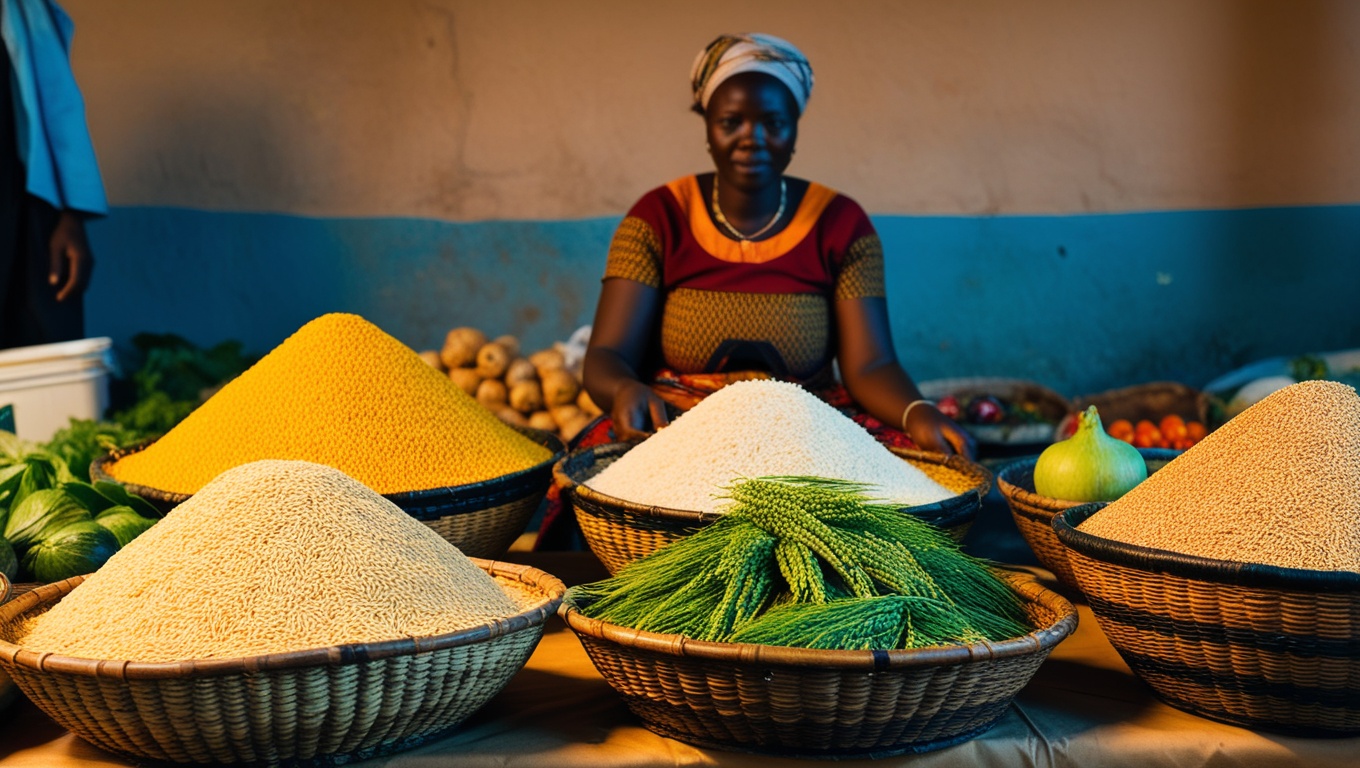
The driver of this divergence is demographic and dietary before it is agricultural. Demand is growing 4 % a year, fuelled by urbanisation and changing diets, while local production gains only 3 % annually. Every year the gap widens mechanically, and it is filled by the international market. Rice has a particular quality: it follows the rural exodus. Easy to store and quick to cook, it takes hold in time-pressed urban households where local cereals (millet, sorghum, yam) demand more preparation. The more an economy urbanises, the higher its per-capita rice consumption climbs, and the wider the gap grows with a rural supply that struggles to modernise.
What the decade shows: dependency is falling, but slowly
First, a piece of good news often forgotten in the debate: the continent is not sinking, it is making progress. Driven by the national rice plans launched after the 2008 food crisis, West African production rose sharply, and the import-dependency rate, which approached half of consumption in the early 2010s, came back down to around one third. The trajectory proves that an inflection is possible: rice dependency is not a destiny, it is the result of a pace. The problem lies precisely in that pace. The gains in supply, though real, remain below those in demand, so the dependency rate falls in proportion while the volume imported keeps rising in absolute terms. That is the whole point: improving a ratio is not enough as long as population and per-capita consumption grow faster than the rice fields.
This divergence between an improving rate and a swelling bill is the heart of the matter. It explains why countries posting real agricultural successes, such as Senegal or Côte d'Ivoire, still see their import spending climb year on year. As long as the slope of supply stays below that of demand, every record harvest is overtaken by even stronger consumption.
Benin, among the region's very top importers
Benin illustrates the pressure on mid-sized economies. With 1.81 million tonnes imported in 2024, up 8.2 % year on year, worth about 405 billion CFA francs (nearly 653 million dollars), it stands among West Africa's very top importers: by value Nigeria leads it by a wide margin, but by volume Benin surpasses Côte d'Ivoire and Senegal. The country even became the world's leading importer of Indian rice in 2024, with about 1.8 million tonnes, ahead of Saudi Arabia and Guinea. A significant share of this volume transits to neighbouring Nigeria (import duty of 10 % in Benin against 30 % in Nigeria), but exposure to world markets remains real nonetheless.
Senegal confirms the upward trend. In 2024 the country spent 315 billion CFA francs, or 564.7 million dollars, on rice imports, up 4.3 % year on year, for volumes rising 6.5 % to 1.38 million tonnes (according to ANSD). Meanwhile self-sufficiency rates remain low: ECOWAS local production covers only about 60 % of demand, and the deficit is even sharper in Senegal, Ghana, Benin and Côte d'Ivoire.
The real bottleneck: yield, not acreage
If local production does not keep up, it is not for lack of land. The limiting factor is agronomic: yield. Work published in Nature Communications by a consortium including AfricaRice establishes that Africa's average rice yield reaches only 2.9 tonnes per hectare, against a potential of 8 tonnes per hectare under the agronomic conditions observed in the field. In other words, the region today harvests only about 36 % of what its plots could produce. The same study places this African yield (2.9 t/ha) roughly one third below that of Southeast Asian farmers (4.3 t/ha). The reservoir therefore lies in the rice fields already under cultivation, not in conquering new land.
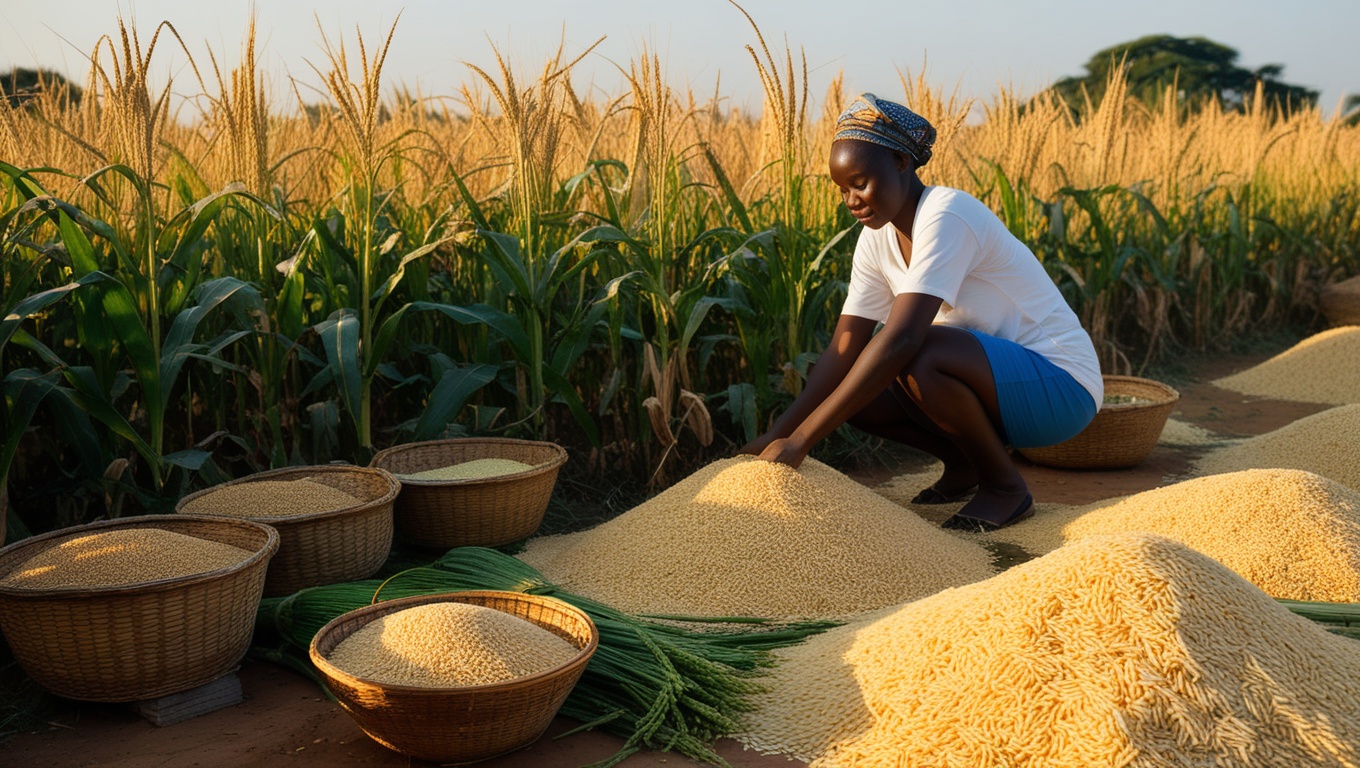
This diagnosis changes everything in public decision-making. Closing half of that yield gap costs far less, ecologically and budgetarily, than expanding acreage. Researchers estimate that nearly 15 million hectares of rice fields in Africa are awaiting agronomic improvement, and that no gain will be achieved without better practices: adapted seeds, water control, balanced fertilisation, mechanisation of transplanting and harvesting. The decisive lever is not expansion, it is the sustainable intensification of what already exists.
The main barriers to closing this gap are well identified and accumulate along the chain:
- Seeds: still limited access to improved, certified varieties, even though they account for most of the yield gain.
- Water: a largely rain-fed rice culture, hence exposed to erratic rainfall, whereas controlled irrigation nearly doubles the potential.
- Inputs and agricultural advice: insufficient fertilisation and too little technical support to apply good practices at the right moment.
- Downstream value chain: deficient milling, drying and storage, which degrade the quality of local rice and feed post-harvest losses instead of a competitive supply.
The rice West Africa is missing is not in land to be conquered, it is in the rice fields already cultivated: 36 % of potential harvested today means the other half is asleep in the soil.
The cost of inaction: the 2050 trajectory
What happens if nothing changes on yields? The same Nature Communications study quantifies the inertia scenario, and it is severe. With unchanged practices, Africa's rice self-sufficiency ratio would fall from 0.57 today to 0.26 in 2050: the continent would cover only a quarter of its needs. The annual deficit would reach 67 million tonnes, the equivalent of about 20 billion dollars of imports a year, or, in physical terms, of 23 million hectares of additional rice fields that would have to be cleared at current yields to produce locally. That is a bill and a land pressure that are hard to sustain.
Conversely, closing half of the yield gap, combined with the trend expansion of acreage, would lift self-sufficiency from 0.57 to 0.82 by 2050, while more than tripling rice production and sparing millions of hectares of forest and savanna. The gap between the two trajectories, 0.26 against 0.82, measures exactly the value of public action: it is not half a point, it is the food future of a continent that hinges on yield.
A dependency that has become a geopolitical vulnerability
Importing is not only costly, it is risky, and the Indian episode of 2022-2024 demonstrated it beyond doubt. India, the world's leading exporter, progressively restricted its sales from September 2022, then banned exports of non-basmati white rice in July 2023, before lifting its restrictions from September 2024. The consequences for the continent were immediate: according to IFPRI, during the restriction period world rice prices held about 100 dollars per tonne above their pre-crisis level, and sub-Saharan African consumers paid a total of 3.8 billion dollars more. A decision taken in New Delhi for domestic-policy reasons translated, thousands of kilometres away, into a direct levy on the purchasing power of West African households.
The vulnerability stems above all from the concentration of supply. Senegal, for example, relied on India for 64 % of its broken-rice imports in 2022, and over 80 % in the first eight months of 2023. When such a dominant supplier turns off the tap, there is no immediate substitute at an equivalent price. Nigeria offers the demonstration of the scale effect: with about 2.1 million tonnes forecast for 2024 worth an estimated 1.31 billion dollars, the country is, according to the USDA, on track to become the world's largest rice importer, ahead of Indonesia and Brazil. An economy of this scale, forced to import at such a pace, exposes the entire sub-region to the same headwinds on the markets.
More production, but more imports: as long as demand grows 4 % and supply 3 %, the gap will keep being filled by the world market, and the bill by public budgets.
What national averages conceal
A national self-sufficiency rate, an imported volume, a bill in dollars: these aggregates frame the issue, but they hide what matters most for whoever must decide where to invest. A national average of 60 % coverage can mask rice basins close to autonomy and urban regions wholly dependent on the port. An average yield of 2.9 t/ha aggregates high-performing irrigated schemes and rain-fed plots barely above one tonne. To decide from the average is to water uniformly a territory whose needs are, in fact, deeply heterogeneous.
This is where the value of fine, disaggregated and geolocated measurement lies, and it is at the core of CRAD's craft. Knowing which irrigated scheme plateaus for want of water control, which cooperative loses 20 % of its harvest at drying, which import corridor feeds which urban market, this is what turns a multi-billion envelope into targeted, measurable investments. The 2035 target cannot be steered with a single national annual figure: it is steered with a living map of yield gaps and value-chain bottlenecks, plot by plot, link by link. Without that granularity, the risk is to invest where it is visible rather than where it is useful.
The 2035 target: a 19-billion-dollar plan
ECOWAS has set a clear course: to achieve regional rice self-sufficiency by 2035, even though local production today covers only about 60 % of demand. The ambition matches the stakes, and so does the price tag: roughly 19 billion dollars of investment would be required, of which nearly 14 billion in capital expenditure and 5 billion in operating costs. Without a step change in productivity and a diversification of production, the regional bill, already above 3.5 billion dollars a year, will only grow heavier, at the expense of food security and the fiscal room of states.
Set against the inertia trajectory quantified by research (a continental deficit of 67 million tonnes and 20 billion dollars of annual imports by 2050), a regional investment of 19 billion spread over a decade is no longer a cost, it is an insurance policy. The question is not whether the region can afford to invest, but how much, year after year, the choice not to do so will cost it.
Key takeaways
- ECOWAS local production covers only about 60 % of demand: the region imports more than 12 million tonnes of rice a year, for a bill above 3.5 billion USD.
- The real bottleneck is yield, not acreage: Africa harvests only 2.9 t/ha, or 36 % of the 8 t/ha agronomic potential, and about one third less than Southeast Asia (4.3 t/ha).
- The cost of inaction is quantified: with unchanged practices, African self-sufficiency would fall from 0.57 to 0.26 by 2050, a deficit of 67 Mt and about 20 billion USD of imports a year.
- Dependency has turned geopolitical: India's 2022-2024 restrictions cost sub-Saharan consumers 3.8 billion USD in extra outlays, with world prices about 100 USD/tonne higher.
- The ECOWAS self-sufficiency target for 2035 requires roughly 19 billion USD of investment, a sum to weigh against the 20 billion in annual losses of the inertia scenario.
Recommendations for West African decision-makers
- Invest in yield before acreage: prioritise improved seeds, water control and agricultural advice to close at least half the yield gap (36 % of potential exploited today), the most cost-effective lever to push local supply above the demand growth threshold.
- Secure the downstream value chain: modernise milling, drying and storage to cut post-harvest losses and make local rice competitive against imports, a condition of the 2035 goal.
- Diversify import origins and build regional security stocks, so as no longer to be hostage to a unilateral decision by a dominant supplier (the Indian case: up to 80 % of Senegal's broken rice in 2023).
- Pool financing at the ECOWAS level: coordinate the roughly 19 billion USD required and harmonise trade measures, framing them as insurance against the 20 billion USD of annual losses in the 2050 inertia scenario.
- Protect the most exposed budgets and households: for economies with a high bill relative to their size such as Benin (653 M USD) or Senegal (565 M USD), pair national rice plans with quantified targets and targeted safety nets in case of a price shock.
- Steer by disaggregated data: build geolocated regional statistical monitoring of yields, volumes, values and losses along the chain, to allocate investment where the gap is largest and continuously track progress towards the 2035 target.
Sources
- WITS - World Bank (Trade Data)
- Ecofin Agency - Senegal rice bill 2024 (+4.3%)
- VivAfrik / ECOWAS - 19-billion-USD rice plan for 2035
- YOP L-FRII - Top 10 African rice importers 2024
- Nairametrics / USDA - Nigeria, world's top importer 2024
- ANSD - Foreign Trade Analysis Note 2024
- van Oort et al., Nature Communications 2024 - Intensifying rice production in Africa (PMC, open access)
- Springer Nature Research Communities - Africa must intensify rice to reduce imports and land conversion
- IFPRI - India lifts rice export restrictions (3.8 billion USD extra cost to sub-Saharan Africa)
- IFPRI / Food Security Portal - Indian restrictions: Senegal's reliance on Indian broken rice