Maize, rice, sorghum: the state of West African cereal production
The question is not whether West Africa is producing more cereals, because it is. The real question is whether it is producing fast enough. In 2024, the region is estimated to have harvested around 73.7 million tonnes of maize, rice, sorghum and millet according to FAO estimates, nearly 700,000 tonnes less than in 2023. This cyclical setback masks a far more consequential underlying tension: while areas expand and Sub-Saharan self-sufficiency climbs from 84% (2010) to 92% (2020), West African yields remain stuck at around 1.2 tonnes per hectare, only 20 to 40% of what the soils would allow. The system is running, but it is running behind a demand that is itself accelerating. Understanding this gap means understanding where to place every franc of public investment over the coming decade.
A cyclical setback against a backdrop of structural progress
The 2024 decline should not obscure the underlying trajectory. While the region is estimated to have lost nearly 700,000 tonnes to settle at around 73.7 million tonnes according to the FAO, driven by rainfall deficits and flooding that hit Nigeria, Mali and Benin, Sub-Saharan Africa's cereal self-sufficiency rose from 84% (2010) to 92% (2020), and this despite a 29% increase in population over the period. The performance is real. But its composition reveals a fragility: according to research published in the journal PNAS, this rise in production between 2010 and 2020 was driven 44% by higher yields, 34% by area expansion and 22% by a simple shift in crops (from millet to maize). In other words, more than half of the gains come not from better soil productivity but from cultivating more land, a lever that is inherently limited.
The regional picture confirms an extreme concentration of production. For the common reference year 2023, the latest vintage available for all countries in World Bank data, nine countries structure West African supply. Nigeria crushes the ranking, followed at a distance by Mali, then by a tight pack including Ghana, Burkina Faso and Niger. Benin, with 2.74 million tonnes, holds a modest place by volume, but its recent momentum, as we shall see, is among the most favourable in the region.
The yield gap: an apparent fate that is not one
The most important figure in this article is not a volume, it is a gap. In 2020, West Africa's average cereal yield stood at about 1.2 tonnes per hectare, against 1.5 for Sub-Saharan Africa as a whole and 2.0 for East and Southern Africa, according to the data mobilised by PNAS. Yet the same work estimates that actual yields represent only 20 to 40% of the agronomic potential of West African soils, given available rainfall. Grain is not short of land or water: it is short of fertiliser, improved seed and agronomic practice. The comparison with East and Southern Africa, which raised its self-sufficiency from 80% to 96% over the decade, shows that West African stagnation is in no way a geographic fate. It is a gap in public policy, and therefore a gap that decisions can close.
This yield deficit has a direct and measurable cause: fertilisation. Sub-Saharan Africa applies on average only 24 kilograms of nitrogen per hectare, which covers just 68% of crop needs according to PNAS. To reach self-sufficiency by 2050 without expanding areas, this input would need to rise to around 75 kilograms per hectare, more than triple the current level. The Africa Fertilizer and Soil Health Summit, held in 2024, recognised precisely this bottleneck. But between the political commitment and the actual spreading in the field of a Beninese farmer, the gap remains intact.
Nigeria, both regional powerhouse and risk factor
With about 28 million tonnes a year (28.05 Mt in 2023, 28.47 Mt in 2024 according to the World Bank), Nigeria alone accounts for roughly 37% of West African cereal production and produces more than the other eight countries in the panel combined. This dominance is also a collective vulnerability: any shock to Nigerian production mechanically ripples across the entire regional market, since no neighbour has the mass to absorb a Nigerian shortfall. The very structure of this production is telling. In 2023/24, maize is estimated at about 11.8 million tonnes, down 7.3% on the back of insecurity in the northern producing zones, sorghum at 6.7 million and milled rice at 5.2 million according to the USDA agricultural service, for a total of about 23.7 million tonnes across these three cereals. While maize leads by volume, sorghum, often seen as a second-tier crop, retains a leading place, underlining its deep roots in Sahelian farming systems and its value as a climate safety net.
Benin: a growth trajectory driven by maize
At the heart of our perimeter, Benin illustrates a positive dynamic running against the regional downturn. According to the World Bank, national cereal production reached 2.91 million tonnes in 2024, up from 2.74 million in 2023, a net gain of nearly 170,000 tonnes in a single season. Maize accounts for more than 75% of this volume, confirming its status as a pillar of Beninese food security. But this result rests largely on area: the country's land under cereals reached an all-time high of about 2.43 million hectares in 2023 according to data reported by CEIC. Yet Benin's average maize yield is stuck at around 1.35 tonnes per hectare according to a study published in ScienceDirect, one of the lowest in its category, explained by insufficient access to inputs and capital and by a still-fragile institutional environment.
Benin gains volume by ploughing more land, not by making each hectare grow more. This is exactly the model that the regional data show running out of steam.
This area-driven growth calls for precise vigilance. As long as the yield stays stuck at around 1.35 tonnes per hectare, every additional tonne requires a newly cleared plot, at the cost of forest cover and soil fertility. Long-term projections extend this logic: under some forward-looking scenarios, maize areas could expand to as much as 2.5 million hectares by 2050. The challenge for Benin is therefore not to cultivate wider, but to cultivate better. For illustration, closing even half the gap with the average Sub-Saharan yield (1.5 t/ha) would be enough to release a substantial additional volume without touching a single extra hectare.
The cost of inaction: doubling demand, an exploding bill
If productivity does not take off, the arithmetic becomes implacable. The PNAS work puts the additional Sub-Saharan cereal demand by 2050 at 98 million tonnes compared with 2020, of which 63 million for West Africa alone, the continent's main demographic hub. To absorb this demand without new land, the Sub-Saharan yield would have to reach 3.2 tonnes per hectare, which would require an annual increase of 58 kilograms per hectare, against only 20 today. For West Africa, the effort needed is equivalent to 7.4 times the current trend in yield growth. Failing that, the trend-extension scenario would imply expanding areas by an additional 14.3 million hectares in this region alone, directly at the expense of forests and savannahs.
The alternative to local production is imports, and their cost is already documented. The FAO estimates Sub-Saharan Africa's food import bill at 62.8 billion dollars in 2024, with a forecast of 65 billion in 2025, a rise of 4% and a third consecutive year of increase. Cereals are the leading item: on their own, they would weigh around 21.9 billion dollars, nearly a third of the total. Every tonne not produced locally is a tonne paid in foreign currency, widening the trade balance, exposing households to the volatility of world prices and funding farm jobs on other continents. The cost of inaction is not hypothetical: it shows up every year in the region's external accounts.
Rice, a magnifying mirror of dependence
No cereal better illustrates the challenge than rice, whose consumption is booming in West African cities while production struggles to keep up. Meeting in Accra on 2 and 3 June 2026, the Rice Investment Roundtable set out a blunt diagnosis: the regional average rice yield does not exceed 2.1 tonnes per hectare, where the Accra Declaration target aims for 4.1 tonnes per hectare by 2035, almost a doubling. The plan aims to double paddy production, bring post-harvest losses below 10% and reduce import dependence to less than 15%. To kick-start this transformation, 1.54 billion dollars in indicative financial commitments were mobilised at the Roundtable, with Togo and Nigeria emerging as the leading beneficiaries, together attracting about 707.5 million dollars in commitments. Distinct from these Roundtable pledges, the World Bank has recently approved its own financing for regional agriculture (on the order of 500 million dollars for Nigeria and 300 million for Togo, Benin's immediate neighbour), which are separate programmes and not a breakdown of the Roundtable total. The signal is clear: rice sovereignty is now treated as a quantified and funded objective, no longer as an intention.
For Benin, this regional context is both a threat and an opportunity. A threat, because the country remains a net rice importer, dependent on world prices and on its neighbours' policies. An opportunity, because Benin's geographic position, a hinge between Nigeria and the Sahel, makes it a natural logistics corridor for regional grain, provided trade barriers fall.
Benin's neighbours: contrasting cereal models
A tour of neighbouring countries reveals distinct specialisations that outline a potential for regional complementarity still underexploited today. Mali produced nearly 9.98 million tonnes in 2023 according to the World Bank, with a mix dominated by maize and rice, and stands out as the Sahelian granary. Côte d'Ivoire is asserting its rise in rice, with cereal production of 3.39 million tonnes in 2023 and expanding milled-rice output, a sign of strengthening domestic capacity. Senegal, finally, produced about 4.25 million tonnes of cereals in 2023, led by rice and maize, despite rainfall constraints weighing on yields. Each country thus strikes its own balance between wet and dry cereals, but these balances remain largely compartmentalised by borders that grain crosses poorly.
The barriers that remain: trade, inputs, climate
Three structural obstacles still limit the region's potential, and they reinforce one another.
- Fragmented trade: restrictive trade policies hamper the movement of grain from one country to another, preventing a market that would benefit from operating as a whole. A Malian surplus does not relieve a Beninese deficit if the grain cannot circulate freely.
- Access to inputs: nitrogen application remains stuck at 24 kg/ha on average across Sub-Saharan Africa, covering only 68% of crop needs, despite the Africa Fertilizer and Soil Health Summit of 2024.
- Erosion of diversity: sorghum and millet, although drought-tolerant, are seeing their production share decline in favour of maize, which reduces the climate resilience of systems just as shocks intensify.
On the human front, the sum of these barriers carries a heavy price: food insecurity is estimated to have affected around 49.5 million people in the region in 2024 according to Cadre Harmonisé analyses, a reminder that the volumes produced are not enough, on their own, to guarantee everyone's access to food. Producing and feeding are not synonymous.
What national averages conceal
A national production of 2.91 million tonnes is a reassuring figure. It is also a misleading one. It blends into the same average a commune in northern Benin where maize yield reaches two tonnes per hectare and a neighbouring commune where it caps at eight hundred kilograms. It adds together a favourable rainy season and a localised water deficit that halved a given area's harvest. It masks the gap between a farm with access to fertiliser and improved seed and one without. Yet the agricultural decision, the one that allocates a subsidised input programme or positions a storage warehouse, is not taken at the level of the national average: it is taken at the level of the commune, the value chain and the season. As long as data remains aggregated, investment remains blind.
This is precisely the conviction that guides CRAD. Measuring finely, disaggregating by territory, by sex of the producer and by season, geolocating yield deficits and logistics bottlenecks, this is what turns a national statistic into an operational decision tool. A yield gap is only of value to decision-making if one knows where it lies, who it affects and why it persists. Fine-grained data does not merely describe the problem: it indicates where to place the lever.
The blind spot of gender in cereal data
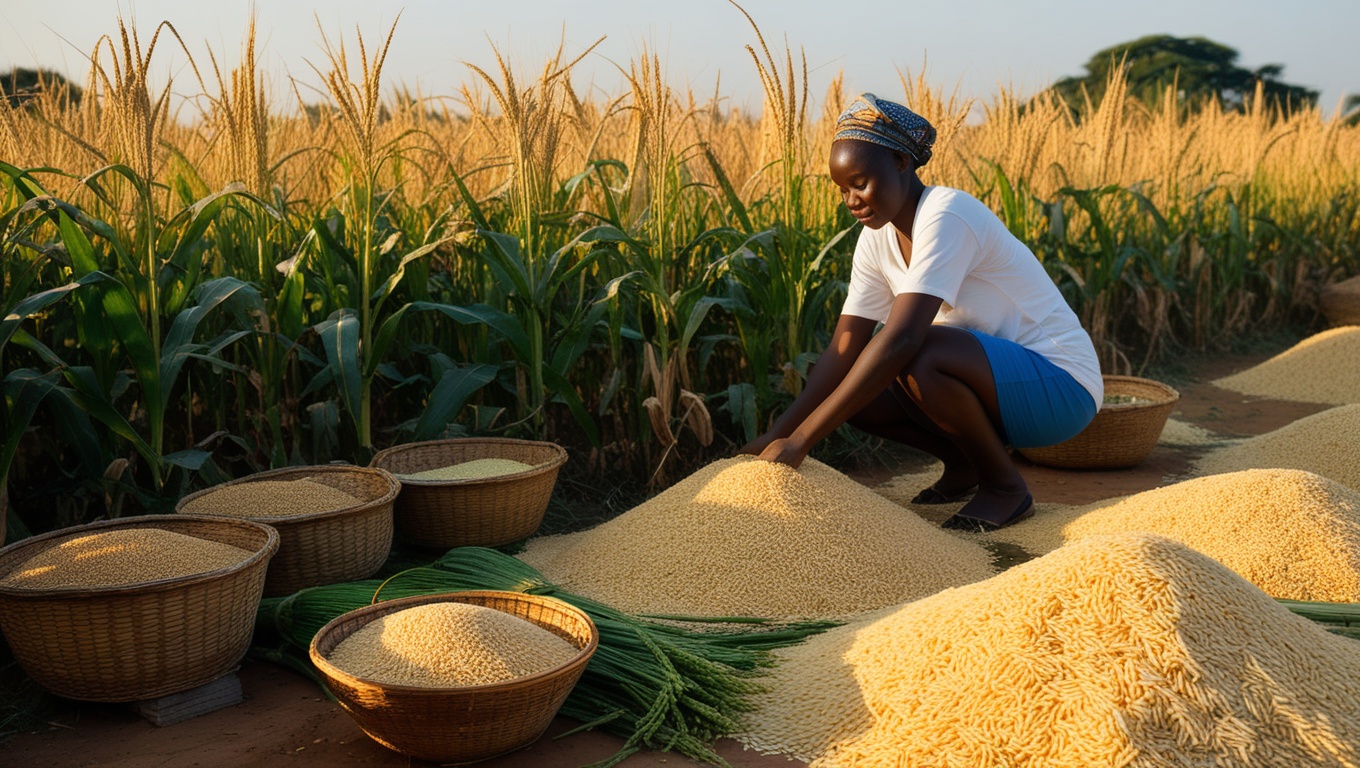
Women carry a decisive share of West African cereal work, from sowing to threshing and through the post-harvest processing that determines losses. Yet agricultural statistics most often remain blind to the sex of the farmer, which prevents the targeting of input, credit and improved-seed policies precisely where the productivity gap is documented as largest. Bringing post-harvest losses below 10%, a stated goal of the regional rice plan, requires acting precisely on the links of the chain held by women. Cereal data disaggregated by gender is not an academic refinement: it is the condition for the billions pledged in Accra to reach those who actually produce the grain.
Key takeaways
- West African yields (1.2 t/ha in 2020) represent only 20 to 40% of the agronomic potential of the soils: the stagnation is a public-policy gap, not a geographic fate.
- More than half of Sub-Saharan production gains in 2010-2020 came from area expansion and a change of crops, not from genuine intensification: a model running out of steam.
- Benin is bucking the trend (2.74 to 2.91 Mt between 2023 and 2024), but by ploughing more land, its maize yield remaining stuck at around 1.35 t/ha.
- The cost of inaction is quantified: 62.8 billion dollars of Sub-Saharan food imports in 2024, of which nearly 22 billion in cereals, and regional demand set to grow by 63 Mt by 2050.
- National averages mask the decisive gaps (commune, value chain, gender, season): without disaggregated and geolocated data, agricultural investment remains blind.
Recommendations for West African decision-makers
- Make yield intensification the absolute priority: aim for a growth trajectory of 58 kg/ha per year, against 20 today, the condition for absorbing 63 Mt of additional demand by 2050 without sacrificing forests and savannahs.
- Translate the Africa Fertilizer and Soil Health Summit (2024) into action by raising nitrogen application from 24 towards 75 kg/ha, through targeted mechanisms for access to and smart subsidy of inputs.
- Seize the momentum of the Accra Rice Investment Roundtable (1.54 billion USD pledged) to build a competitive Beninese rice value chain and position the country as a regional logistics corridor.
- Lift intra-regional trade barriers to turn one country's surplus (Mali) into its neighbour's food security (Benin), instead of paying for grain in foreign currency outside Africa.
- Invest in climate-resilient varieties for sorghum and millet, to halt the decline of their share and preserve the climate safety net of Sahelian systems.
- Build agricultural data systems disaggregated by commune, by season and by gender, to target investment where the yield gap is real, rather than blindly on national averages.
Sources
- World Bank Open Data, Cereal production (AG.PRD.CREL.MT)
- PNAS, Prospects for cereal self-sufficiency in sub-Saharan Africa (2025)
- PNAS / PMC, Prospects for cereal self-sufficiency in sub-Saharan Africa, full text
- FAO GIEWS, Global Information and Early Warning System
- FAO GIEWS Country Brief, Benin
- FAO GIEWS Country Brief, Mali
- FAO GIEWS Country Brief, Senegal
- USDA Foreign Agricultural Service, Nigeria, PSD database
- USDA Foreign Agricultural Service, Côte d'Ivoire Grain and Feed Annual
- FAO food outlook: Sub-Saharan Africa food imports to reach 65bn USD in 2025
- World Bank / Milling MEA, West Africa rice value chain and Accra Rice Investment Roundtable (2026)
- Ecofin Agency, West Africa Seals $1.54 Billion Rice Investment Deal in Accra (Togo and Nigeria, combined $707.5M)
- USDA FAS, Nigeria Grain and Feed Update (maize 2023/24 at 11.8 Mt, down 7.3%)
- ScienceDirect, Determinants of maize farmers' performance in Benin, West Africa
- CEIC, Benin Land under Cereal Production
- Cadre Harmonisé, food security analyses for West Africa and the Sahel