Agriculture in West Africa: the leading employer, an undervalued contribution to GDP
In most West African countries, one worker in two tills the land, yet the value they produce accounts for only a quarter or a fifth of the national economy. This is no trivial statistic: it is the central equation of regional development. As long as the share of agricultural employment exceeds the share of agricultural GDP, millions of families will remain locked into an activity that is essential but poorly rewarded. The good news is that this gap is neither natural nor permanent: it can be measured, it can be broken down, and wherever the right policies have been pursued, it has narrowed.
A sector that sustains the region
Across Sub-Saharan Africa, agriculture still employs close to half the workforce, around 50 percent in 2024 according to the World Bank. In West Africa, dependence varies sharply from one country to another. Niger has the region's highest share of agricultural workers, 73.5 percent in 2024, followed by Mali (63.5 percent) and Burkina Faso (52.2 percent). At the other end, more diversified economies such as Senegal (30.7 percent), Nigeria (34.1 percent) and Ghana (35.2 percent) nonetheless remain heavily reliant on their rural sector. Benin sits in the upper-middle range, with 41.1 percent of its workforce in the fields.
This snapshot hides a human reality: behind every percentage point are hundreds of thousands of households whose income, food security and trajectory depend directly on a rainy season, a market price or access to fertiliser. Which is to say that the productivity of this sector is not a technical question reserved for economists, but the primary determinant of the region's standard of living.
A share of GDP that does not follow
When this labour force is set against the wealth it creates, the gap is striking. Mali draws the region's largest GDP share from agriculture, 33.3 percent in 2024, yet the sector accounts for 63.5 percent of its workers. Niger shows 34.5 percent of agricultural GDP for 73.5 percent of employment. In Benin, agriculture represents 24.2 percent of GDP while mobilising 41.1 percent of the workforce. Across Sub-Saharan Africa the contrast is even sharper: agriculture employs close to half of all workers but accounts for only about 18 percent of GDP. Everywhere, the same pattern: the share of employment clearly exceeds the share of value added.
When 73 percent of workers produce 34 percent of the wealth, the problem is not agriculture, it is its productivity.
The employment-GDP gap, measured country by country
To make the phenomenon concrete, the clearest approach is to set the share of employment against the share of GDP, country by country. The gap between the two is the direct marker of the productivity deficit: the wider it is, the less each agricultural worker produces relative to a worker in other sectors. Niger shows the widest gap in the region, nearly 39 points (73.5 percent of employment against 34.5 percent of GDP), followed by Mali (more than 30 points). Conversely, Nigeria has the narrowest gap, around 8 points, a sign of agriculture that is relatively more productive and better integrated into value chains.
Measuring real productivity: what does an agricultural worker produce?
The employment/GDP ratio is only an index. The direct measure is value added per agricultural worker. Regional data reveal a divide within West Africa itself: according to the African Development Bank, value added per worker often exceeds 500 dollars in several West and Central African economies, but remains between 100 and 200 dollars in the Sahel countries. By way of comparison, the World Bank estimates that non-agricultural labour in Africa is about six times more productive than agricultural labour, measured on national accounts. This cross-sector productivity gap, one of the highest in the world, is precisely what keeps agricultural income below the national average.
One important nuance, stressed by the World Bank, deserves to be measured locally: part of the gap comes from the volume of hours worked, not only from hourly output. Agricultural work is seasonal and heavily underemployed outside the growing season. Adjusted to effective hours worked, the productivity gap narrows appreciably. The operational conclusion: creating off-season activity (processing, dry-season irrigation, livestock) can lift agricultural income as much as raising yields themselves.
This distinction has a direct bearing on policy design. If one reasons in value per worker per year, the diagnosis pushes to move people out of agriculture. If one reasons in value per hour worked, the diagnosis instead calls for making better use of the available time of the agricultural workers already in place. The two readings do not lead to the same investments, and only a fine-grained measure, at household and seasonal level, can settle the matter. It is a textbook case of why data granularity is not a statistical refinement, but a determinant of the budgetary choice.
The mechanisms: why productivity stays low
The productivity deficit is no mystery: it breaks down into identifiable factors, each quantifiable and therefore actionable. Three weigh particularly heavily in the region.
- Under-fertilisation of soils. Africa applies on average around 18 kg of fertiliser per hectare of cropland, against a world average of about 135 kg, barely 13 percent. Yet the Abuja Declaration set a target of 50 kg per hectare back in 2006, still unmet by the vast majority of countries.
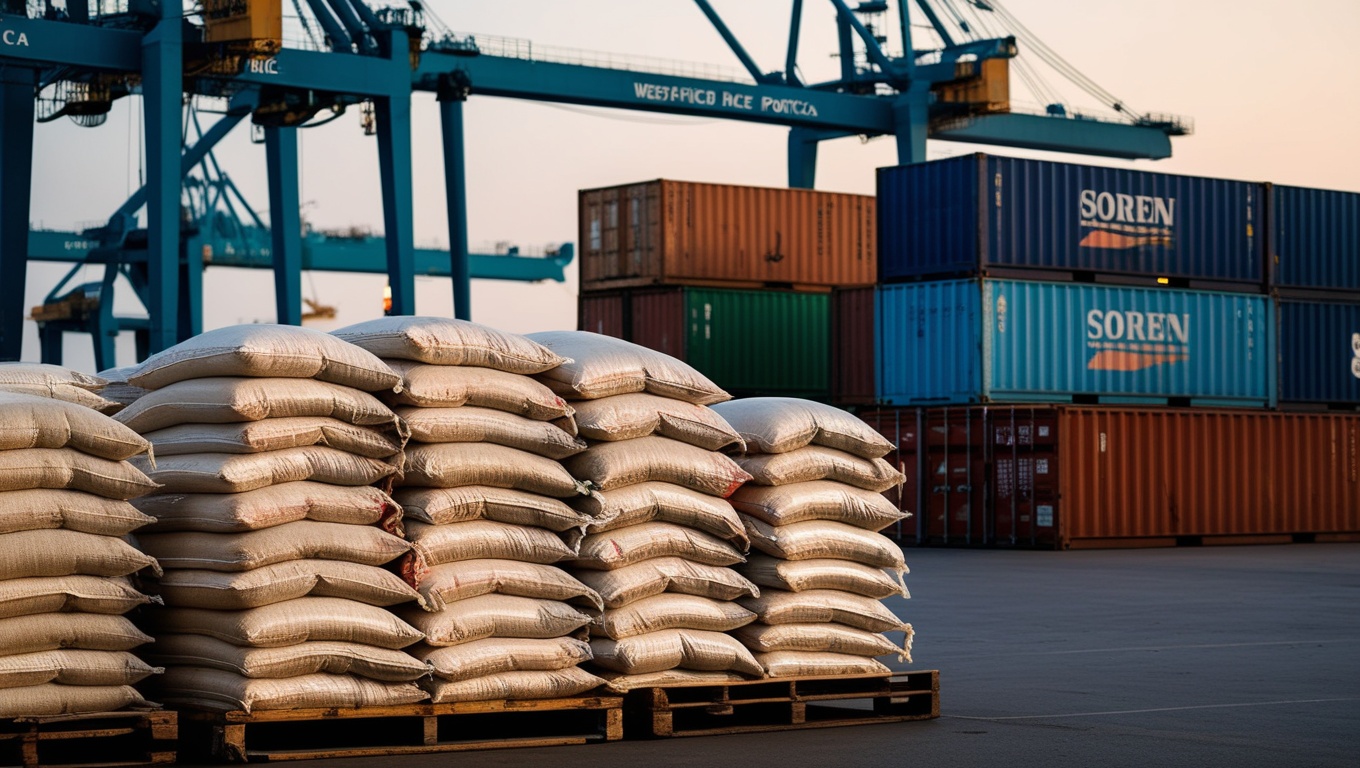
- Massive post-harvest losses. The FAO estimates that at least 14 million tonnes of cereals are lost every year on the continent, worth more than 4 billion dollars. As much as 37 percent of the food produced in Sub-Saharan Africa is lost between field and plate. Output that has already been produced is thus destroyed before creating any value or feeding anyone.
- Under-mechanisation and weak value chains. Most output remains exported or consumed raw, without local processing that would capture downstream value added. Income therefore stays concentrated on the least remunerative stage of the chain.
Productivity, a real lever: the Nigerian counter-example
The employment-GDP gap is not inevitable. The most telling counter-example in the region remains Nigeria: agriculture there employs one third of workers (34.1 percent) for one quarter of GDP (25.9 percent), a markedly more favourable ratio than in the Sahel countries, where each worker produces far less. Where mechanisation, access to modern inputs and integrated value chains advance, the gap narrows. Where they are lacking, the sector risks remaining a reservoir of poverty despite its numerical importance. Agricultural labour productivity has, moreover, risen across Africa since the early 2000s, proof that the trajectory can be changed.
The case of Benin: a slow transition
Benin illustrates a structural transformation that is underway but gradual. Agricultural employment fell from 43.7 percent in 2010 to 41.1 percent in 2024, a decline of less than three points in fourteen years. Its contribution to GDP, meanwhile, peaked at 28.5 percent in 2021 before easing back to 24.2 percent in 2024. These slow movements reveal an economy that is diversifying without abrupt rupture, but where agriculture remains a pillar of employment far more than of value creation.
The cost of inaction
Changing nothing has a price, and that price can be counted. Post-harvest losses alone deprive Sub-Saharan agriculture of more than 4 billion dollars a year: output already sown, watered and harvested, but lost for want of storage, drying and logistics. This destroyed value would be enough, according to the FAO, to cover the minimum annual food needs of at least 48 million people. To this is added the opportunity cost of under-investment: despite the commitment of the Maputo and then Malabo declarations to allocate 10 percent of public budgets to agriculture, no country was on track to meet the targets by 2025, according to the African Union itself. Nigeria, for instance, allocated only about half of the 10 percent objective in its 2025 budget.
Maintaining a high employment-GDP gap therefore means accepting three cumulative consequences: durably low rural incomes that fuel poverty and out-migration, greater dependence on food imports that weighs on trade balances, and a climate vulnerability all the sharper for low yields. Inaction is not a neutral status quo: it is a cost that accumulates with every season.
This cost is compounded by a crowding-out effect on youth. When a sector employs the majority of workers but offers only subsistence incomes, it becomes unattractive to new generations, who turn away from an agriculture perceived as a dead end. The productivity deficit then turns into a deficit of successors, and modernisation becomes harder for lack of trained hands ready to invest in the sector. Breaking this cycle means making agriculture profitable before hoping to make it desirable, which brings us back, once again, to the question of measured productivity.
What national averages conceal
The figures presented here are national averages. Yet no effective agricultural policy is steered by the average. Behind a single national agricultural employment rate lie considerable disparities: between a mechanised cotton district and a subsistence food-crop district, between an irrigated zone and a rain-fed one, between an export-integrated value chain and a fragmented one. A country's employment/GDP ratio can mask pockets where each worker produces three or four times less than the average, and it is precisely there that the productivity reserve lies.
This is the conviction that guides CRAD's approach: aggregate data shapes a narrative, disaggregated and geolocated data shapes a decision. Measuring productivity by value chain, by district and by farm profile, and tracking it over time, makes it possible to target fertiliser, credit, advisory services and mechanisation where the marginal return on public investment is highest. It is the difference between spreading an agricultural budget thinly and concentrating it where it truly transforms lives.
Aggregate data shapes a narrative; disaggregated and geolocated data shapes a decision.
The blind spot of gender
One final factor, often invisible in national accounts, weighs heavily on regional productivity: gender inequality. In many African countries, women make up around 60 percent of the agricultural workforce and account for up to 80 percent of food production. Yet, at equal farm size, the FAO measures a land productivity gap of 24 percent to women's disadvantage, for want of equal access to land, inputs, credit and advisory services. This gap carries a macroeconomic cost: it is estimated at 95 billion dollars a year for Sub-Saharan Africa. Globally, closing gender gaps in agriculture could raise GDP by around 1 trillion dollars and reduce food insecurity for 45 million people. Reducing the agricultural productivity deficit and reducing gender inequality are, to a large extent, the same undertaking. Yet these inequalities remain largely invisible in aggregate statistics: a national productivity rate says nothing of the double constraint of time and resources that bears on women farmers. Here too, only data disaggregated by sex can turn a moral observation into a targeted, budgeted policy.
Key takeaways
- In West Africa, the share of agricultural employment exceeds the share of agricultural GDP everywhere: 73.5 percent of employment for 34.5 percent of GDP in Niger, 41.1 percent for 24.2 percent in Benin. The gap directly measures the productivity deficit.
- This divergence reflects a lack of productivity, not a surplus of workers: non-agricultural labour in Africa is about six times more productive than agricultural labour, according to the World Bank.
- Three mechanisms explain it: under-fertilisation (18 kg of fertiliser/ha against 135 worldwide), post-harvest losses (more than 4 billion dollars/year, up to 37 percent of food lost) and the absence of local processing.
- The cost of inaction can be counted: post-harvest losses alone would be enough to feed 48 million people, and no African country was on track to meet the 10 percent agricultural budget pledge (Maputo/Malabo) by 2025.
- National averages conceal what matters most: disaggregated, value-chain-level and geolocated measurement is the precondition for targeting public investment where it truly transforms incomes.
Recommendations to West African decision-makers
- Honour the commitment of 10 percent of public budgets to agriculture (Maputo/Malabo) and tie that spending to productivity indicators tracked over time, not merely to production volumes.
- Close the input gap by aiming for the Abuja target of 50 kg of fertiliser per hectare through targeted schemes (input vouchers, improved seeds, dry-season irrigation), as a priority in the Sahel countries where the employment-GDP gap exceeds 30 points.
- Tackle post-harvest losses (storage, drying, logistics, packaging): this is the lever with the best cost-benefit ratio, since it saves value already produced, more than 4 billion dollars a year region-wide.
- Develop agro-industry and local processing to capture downstream value added, instead of exporting raw commodities, and create off-season rural employment.
- Explicitly target the gender gap: equal access for women to land, credit and agricultural advisory services; closing the 24 percent productivity gap is one of the most profitable reserves (95 billion dollars/year lost in Sub-Saharan Africa).
- Steer with disaggregated data: set up tracking of employment/GDP ratios and productivity by value chain, by district and by farm profile, to concentrate investment where the marginal return is highest.
Sources
- World Bank, Employment in Agriculture (SL.AGR.EMPL.ZS)
- World Bank, Agriculture Value Added (% of GDP) (NV.AGR.TOTL.ZS)
- World Bank, Sub-Saharan Africa: agriculture value added (% of GDP)
- World Bank, Sub-Saharan Africa: employment in agriculture (% of total employment)
- World Bank, Labor Productivity and Employment Gaps in Sub-Saharan Africa
- World Bank, agriculture value added per worker (NV.AGR.EMPL.KD)
- World Bank, Is Post-Harvest Loss Significant in Sub-Saharan Africa?
- FAO/OpenKnowledge, reducing post-harvest losses in grain supply chains in Africa
- ScienceDirect, Africa fertiliser and soil health strategy (fertiliser use per hectare)
- AfDB, Abuja Declaration (50 kg fertiliser/ha target)
- African Union, Extraordinary Summit on Post-Malabo CAADP (10 percent commitment)
- FAO, International Year of the Woman Farmer 2026 (24 percent gender gap, 1 trillion USD)
- UN Women, The Cost of the Gender Gap in Agricultural Productivity (95 billion USD)
- ILO, Can Africa Harness Agriculture for Decent Job Creation
- FAO, FAOSTAT (agricultural productivity)
- ISS Africa Futures, Africa Agriculture Thematic Overview