Livestock and pastoralism: 100 million cattle of mobile wealth, poorly measured and under-financed
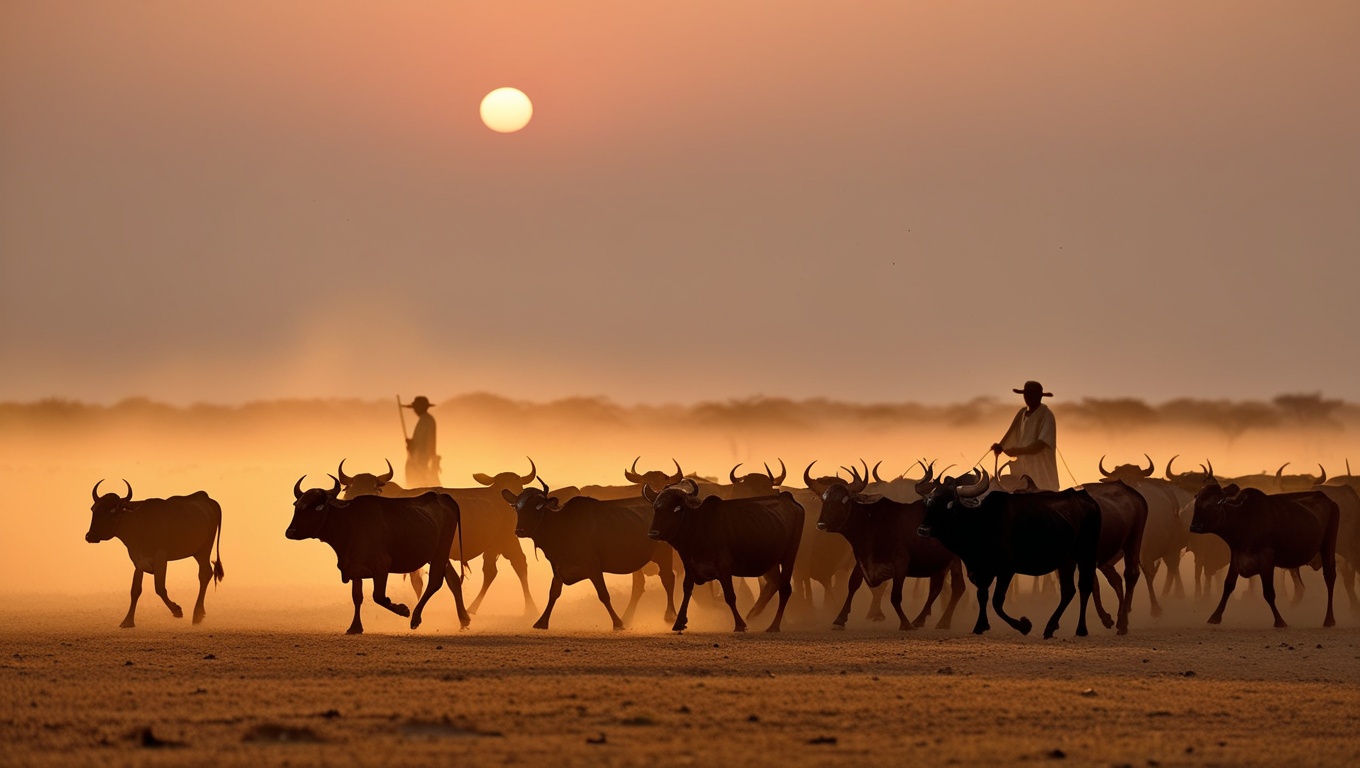
This is wealth that walks. For the six main Sahelian livestock countries (Chad, Niger, Nigeria, Mali, Burkina Faso, Senegal), the cattle herd grew from 45.8 million head in 2000 to 105.4 million in 2023 according to FAOSTAT, a growth rate that far outpaces that of the population. Region-wide, West Africa and the Sahel count some 112 million cattle, 170 million sheep and 224 million goats. This capital on the hoof supports more than 20 million pastoralists, serves as savings and insurance for nearly half of the region's households, and accounts for as much as 44% of agricultural GDP in the Sahelian countries. And yet this wealth is among the least known on the continent: the FAO itself judges its own herd figures unreliable, trade flows escape customs, and the sector receives a derisory fraction of agricultural budgets. You do not finance, and you do not protect, what you do not measure.
Capital on the hoof of more than 100 million head
The geography of West African livestock pits two worlds against each other. On one side, the Sahelian producer countries, where the herd is immense relative to the human population; on the other, the coastal consumer countries, less endowed with herds but rich in urban markets. In 2023, Chad tops the regional ranking with 37.6 million cattle, ahead of Nigeria (20.9 million) and Niger (19.2 million). Benin, with 2.5 million head, sits among the coastal countries with a modest herd, at a level comparable to Ghana and Cote d'Ivoire. This hierarchy of numbers is the bedrock of the entire pastoral economy: it maps out the zones from which the animals set off and those toward which they converge.
The Sahelian paradox: more animals does not mean more value
Wealth in head does not mechanically convert into value added, and that is where the picture grows complicated. Nigeria, with its 20.9 million cattle, produces only 319,000 tonnes of beef in 2023, while Chad, barely better endowed in head, produces 550,000. In other words, a numerically comparable herd can yield twice as much or half as much depending on breeds, feed, slaughter age and value-chain organisation. Productivity per animal, not head count alone, is the true performance indicator of a livestock system, and it is precisely the one that regional statistics struggle most to capture.
A spectacular Sahelian surge, but not everywhere
The expansion of the Sahelian herd is one of the major, yet quiet, economic facts of the past quarter-century. Chad has more than doubled its cattle herd since 2010, rising from 19.2 to 37.6 million head. Niger followed the same trajectory, from 9.0 million in 2010 to 19.2 million in 2023. This rapid growth reflects both a demographic dynamic in the herds and, no doubt, better statistical coverage. Conversely, Nigeria shows far slower growth (16.6 million in 2010, 20.9 in 2023), and Burkina Faso displays a jagged trajectory, marked by a decline between 2015 and 2020 that reflects insecurity and climate shocks in its pastoral zones.
An economy of mobility: transhumance and trade corridors
The West African pastoral system rests on a simple and ancient principle: movement. Seasonal transhumance drives the herds toward pasture wherever it is found, from north to south in the dry season, and back again with the first rains. Onto this ecological mobility is layered a commercial mobility, from the producer Sahel toward the coastal consumer cities. Three large basins structure this regional trade: a Western axis feeding Senegal, a Central axis supplying Ghana and Cote d'Ivoire, and an Eastern axis oriented toward Nigeria. Nearly two-thirds of the animals traded cross at least one border before reaching the consumer.
This cross-border trade is no marginal phenomenon: it is the backbone of animal-protein supply for the entire region. Transhumant pastoralism alone provides about 65% of the beef produced in West Africa, 40% of small-ruminant meat and 70% of milk. Far from being an archaism, mobility is the production mode best suited to arid environments where the forage resource is, by nature, scattered and unpredictable. To fight it would be to undermine the region's leading source of meat.
Small ruminants and milk, the other face of the herd
Reducing Sahelian livestock to cattle would be an analytical error. Small ruminants, sheep and goats, are an equally strategic form of wealth, more accessible to modest households and quicker to rebuild after a shock. Nigeria alone counts 140.8 million head in 2023, ahead of Chad (98 million) and Mali (55.5 million). It is these animals, easy to sell in a pinch, that play the role of precautionary savings for rural families. They best embody the insurance function of livestock, this ability to convert an asset into cash instantly when the harvest fails or an expense arises. Nearly half of the region's population thus owns livestock, making the animal the most widespread savings account in West Africa.
Nearly half of the region's population owns livestock. It is the most widespread savings account in West Africa, and the least well counted.
Milk, or how a local asset is allowed to be downgraded
Milk alone tells the story of squandered, poorly valued wealth. Niger produces 923,800 tonnes of cow milk in 2023, Nigeria 526,500, Mali 311,400: the raw material exists, in abundance. Benin itself produces 136,900 tonnes. But for lack of organised collection, a cold chain and local processing, this milk struggles to reach urban consumers on competitive terms. The gap is filled by milk powders imported from Europe, cheaper to buy but which suffocate the local value chain and drain foreign currency.
The figures on dairy self-sufficiency are telling. In Senegal, the share of consumed milk of local origin fell from 41% in 2000 to 20% in 2018. In Ghana, the drop is even steeper, from 52% in 1996 to 15% in 2018. In less than a generation, two countries let imports take control of a market their own herds could supply. This decline is no agronomic inevitability: it is the result of an absence of organised collection and of a trade policy that failed to protect domestic production.
The real economic weight: a strategic yet invisible sector
What is livestock really worth in the region's economies? In the Sahelian countries, livestock can account for as much as 44% of agricultural GDP, against only about 5% in the coastal countries, a considerable regional gap. The weight of the rural world, of which livestock is a central component in the Sahel, can be read in the share of agriculture in the broad sense in GDP: 44% in Niger, 31.4% in Mali, 27.7% in Nigeria, against 15.9% in Cote d'Ivoire. These orders of magnitude place livestock among the very top economic sectors of the Sahel, on a par or nearly so with the largest national contributors. This front-rank economic weight contrasts violently with the sector's marginal place in public budgets, a gap that alone sums up pastoral under-investment.
For exports, livestock is one of the few products for which West Africa runs intra-regional trade surpluses. The value of ECOWAS livestock exports is estimated at around 800 million dollars a year, a large share of which nonetheless escapes official statistics. It is a first-order engine of regional integration: the Sahel sells its animals, the coast buys its meat, and money circulates from one country to another. Few value chains illustrate so concretely the interdependence of West African economies.
The cost of inaction: under-investment, lost milk and conflict
The contrast is striking between the sector's economic weight and the public attention it receives. Livestock captures on average barely 10% of agricultural spending, or on the order of 1% of national budgets in the Sahel, even though it represents a major share of rural value added. This chronic under-investment has a price, and it is paid on several fronts at once: inadequately monitored animal health, deficient market infrastructure, non-existent milk collection and, more serious still, a growing competition for unmanaged resources.
This pressure on pastures and water points fuels conflicts between herders and farmers, whose human toll has become tragic. In Nigeria, these clashes have killed more than 19,000 people since 1999. Behind this figure lies the failure of shared land management: when transhumance corridors are neither mapped nor secured, when agricultural expansion nibbles away at grazing routes without consultation, violence takes the place of absent rules. The cost of inaction is therefore measured not only in economic shortfall, but in human lives.
- Derisory financing. Livestock receives about 10% of agricultural spending, or close to 1% of Sahelian national budgets, wholly out of proportion with its real weight (up to 44% of agricultural GDP).
- An eroding dairy sovereignty. For lack of organised collection, milk self-sufficiency collapses (Senegal from 41% to 20%, Ghana from 52% to 15%) to the benefit of imported powders.
- A heavy human cost. Herder-farmer conflicts have killed more than 19,000 people in Nigeria since 1999, for want of managing and securing pastoral resources.
What the averages hide: inequality and the informal economy
As so often, national figures smooth over sharply contrasting realities. Behind the image of a homogeneous pastoral society lies a considerable inequality of wealth: in the Sahel, about 15% of households hold 70% of the large herds, while the majority of small herders, owning only a few head, remain highly vulnerable to droughts. One bad season, and their entire capital melts away. To treat pastoralists as an undifferentiated group is to miss those most in need of support, and to design policies that benefit chiefly the best endowed.
The averages also mask an enormous share of activity: the informal economy. According to several experts, official statistics would capture only about a third of the real value of cross-border livestock trade. In other words, two-thirds of this trade takes place outside any registration, escaping customs as well as national accounts. A sector most of whose value is invisible can be neither properly taxed nor properly defended in budget arbitration. Statistical invisibility translates directly into political invisibility.
Official statistics would capture only about a third of the real value of cross-border livestock trade. The remaining two-thirds are wealth that no one counts, and that no one protects.
Measuring mobile wealth: the CRAD angle
The central problem of West African pastoralism is not so much its reality as its measurement. The herd figures themselves are judged unreliable by the FAO, estimates diverge sharply from one source to another, and cross-border trade flows remain largely in the blind spot of statistics. The best existing monitoring effort, the CILSS database, recorded 42,251 animal movements on selected corridors between 2013 and 2017: valuable work, but one that covers only a fraction of the routes and years. This data deficit is no technical curiosity, it is the lock that blocks any serious pastoral policy.
It is precisely this deficit that CRAD is equipped to fill. Digital field data collection makes it possible to census herds and track their composition with a precision that decadal censuses never reach. Geolocated monitoring of markets and transhumance corridors turns invisible flows into usable data series. Finally, robust monitoring-and-evaluation systems make it possible to measure, value chain by value chain and zone by zone, the value added actually created. Precisely documenting herds, flows and value added is not an academic exercise: it is the precondition for any credible pastoral policy and for effective advocacy toward better financing of the sector.
The stakes go beyond statistics. Finely mapping transhumance corridors means giving oneself the means to prevent conflicts upstream. Monitoring markets in near-real time means being able to anticipate price crises and livestock movements during drought. Disaggregating data by herd size and by owner's sex means targeting public support toward vulnerable herders rather than toward the best off. Pastoral data, when it is geolocated, disaggregated and repeated over time, ceases to be a figure and becomes an instrument of public policy.
From findings to decisions
Sahelian and West African pastoralism concentrates a paradox that captures many of the continent's challenges: an immense, ancient wealth, deeply adapted to its environment, but so poorly measured that it becomes politically fragile. More than 100 million cattle, more than 20 million people who live from them, up to 44% of Sahelian agricultural GDP, and yet barely 1% of national budgets. This dissonance between real weight and public attention will not be corrected by declarations, but by data that finally make the sector visible.
The sequence is clear: first measure, then finance, finally secure. You cannot defend in budget arbitration a sector whose value you ignore; you cannot prevent conflicts over resources you have not mapped; you cannot target support without disaggregated data. Turning the mobile wealth of livestock into counted wealth is the first step toward wealth that is better protected and better shared.
Key takeaways
- The cattle herd of the six main Sahelian livestock countries grew from 45.8 million head in 2000 to 105.4 million in 2023 (FAOSTAT), a faster growth than the population.
- Wealth in head does not make value: Nigeria (20.9 M cattle) produces only 319,000 t of meat, against 550,000 t for Chad, with a comparable herd.
- Transhumant pastoralism, far from being an archaism, provides about 65% of beef, 40% of small-ruminant meat and 70% of milk in the region.
- The sector is massively under-financed (about 1% of national budgets) and under-measured: statistics would capture only a third of the value of cross-border trade.
- The cost of inaction is paid in lost dairy sovereignty (Senegal from 41% to 20%) and in human lives (more than 19,000 dead in the Nigerian conflicts since 1999).
Recommendations for West African decision-makers
- Build herd census systems through digital field data collection, repeated regularly, to replace estimates that the FAO itself judges unreliable and to ground policies on solid figures.
- Map and secure transhumance corridors and water points, drawing on geolocated data, in order to prevent herder-farmer conflicts upstream rather than bear their human cost.
- Align public financing with the sector's real weight, raising livestock's share well beyond the current 10% of agricultural spending, to match its contribution to agricultural GDP.
- Organise the collection and processing of local milk (cold chain, collection centres, mini-dairies) to halt the fall in dairy self-sufficiency in the face of imported powders.
- Extend and sustain the monitoring of livestock flows on regional corridors, building on the work of CILSS, to make the informal cross-border economy visible and taxable.
- Systematically disaggregate pastoral data by herd size and by owner's sex, in order to target public support toward vulnerable small herders and not toward the 15% of households that hold 70% of the large herds.
Sources
- FAOSTAT, Production (Crops and Livestock Products), herds and production
- World Bank, Data (agricultural value added, % of GDP, API)
- OECD/SWAC, The Structure of Livestock Trade in West Africa (Valerio, 2020, West African Papers No. 29)
- ECOWAS/ECOWAP, Livestock sector, development and animal health
- World Bank (Africa Can blog), Reinforcing pastoralism in the Sahel and West Africa (PRAPS)
- Inter-reseaux / SOS Faim, The Sahel Livestock Paradox: High Stakes, Low Support (2015)
- Cirad, Local or imported: what is the most sustainable option for milk in the Sahel? (2020)
- African Journal of Range & Forage Science, Transhumance pastoralism in West Africa (2022)
- CILSS, PREDIP, Regional Dialogue and Investment Project for Pastoralism and Transhumance
- FAO, Agricultural production statistics 2010-2024 (world meat and milk production)
- Herder-farmer conflicts in Nigeria (sourced synthesis, Global Terrorism Index)