Cashew: West Africa produces half the world's cashews, but exports the value
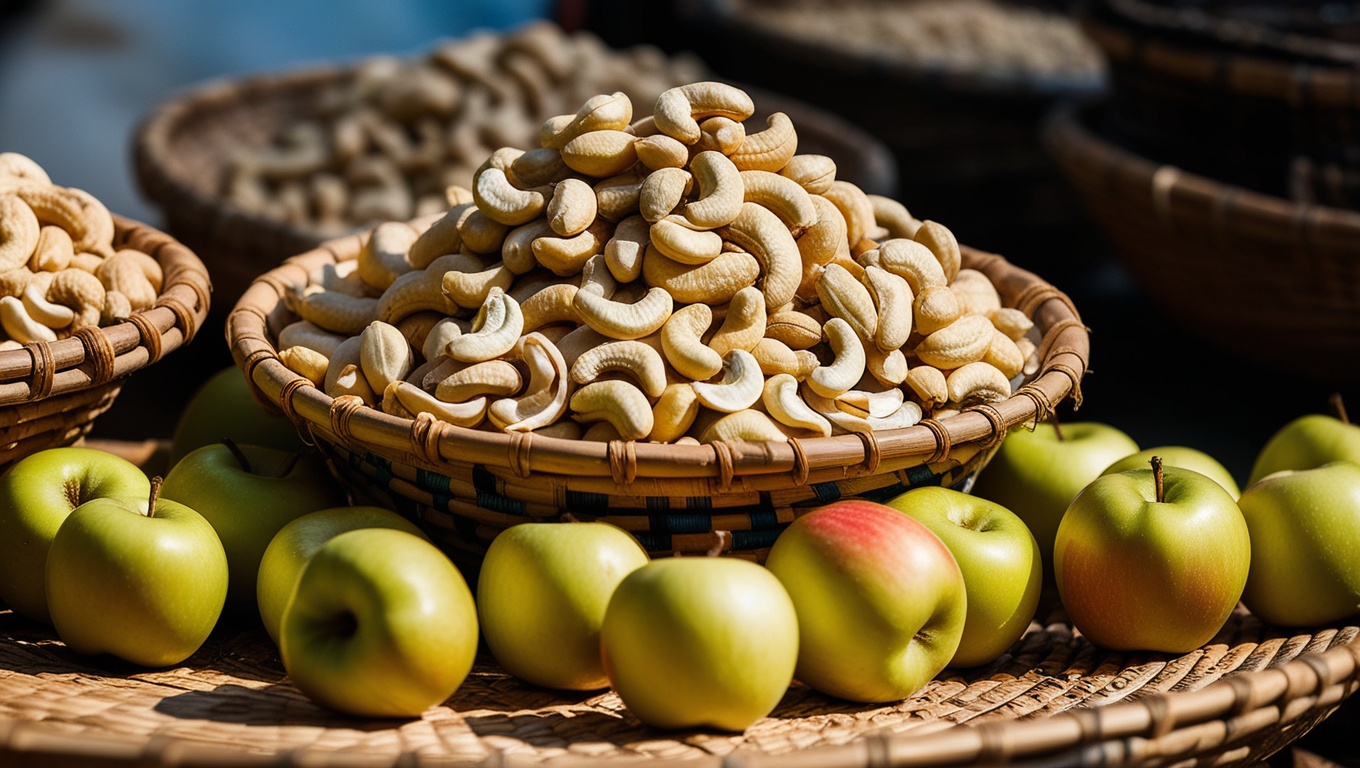
West Africa is the world's largest cashew orchard and the last to benefit from its wealth. In 2023, the region harvested nearly 3 million tonnes of raw cashew nuts, about 45 % of global supply, yet it exported 84 % of them raw to Vietnam and India. Processing, and therefore jobs, foreign exchange and margin, happens in Asia: in 2018, the cashew kernel sold by India to the European Union was worth about 3.5 times the price paid to the Ivorian grower. The question facing producer states is not whether they can grow more nuts, they already dominate the market, but whether they will finally decide to keep at home the value they send elsewhere to be shelled every year.
An agricultural giant that remains a mere supplier of raw material
The figures from the 2023 season leave no doubt about the region's weight. According to N'kalô estimates relayed by Food Business Africa, the West African harvest jumped 15 % to reach nearly 3 million tonnes, about 45 % of world production. Côte d'Ivoire, the world's leading producer since 2015, accounts on its own for 1.36 million tonnes, nearly 40 % of global supply. Benin, with more than 227,000 tonnes, ranks among the very top countries on the continent. The region therefore enjoys the dream comparative advantage: the climate, the soils and the orchards to dominate a growing world market.
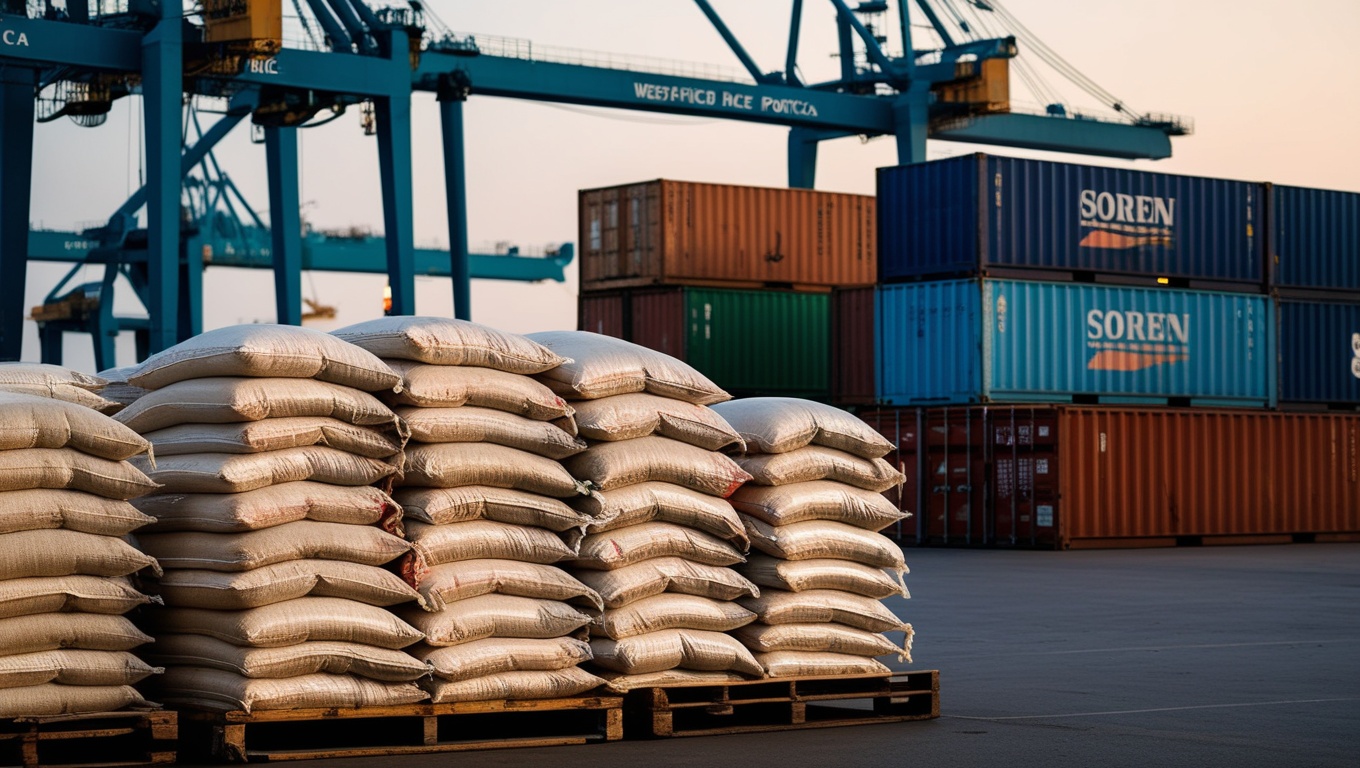
That advantage, however, stops at the edge of the field. The raw nut, or raw cashew nut (RCN), leaves the continent almost untouched: barely dried and bagged, it heads to Asia where it will be shelled, graded and turned into a marketable kernel. The value created by these operations, the jobs they generate and the tax revenue they bring in all remain outside Africa. The paradox is striking: the region that grows almost half the world's cashews reaps only a fraction of the wealth. And this is not a passing agronomic handicap but a position durably lodged at the bottom of the value chain, that of the supplier of a raw commodity whom buyers play off against one another.
The value-added gap: processing happens in Asia
The heart of the problem comes down to a single figure. Over the period 2014-2018, India and Vietnam accounted for 98 % of world imports of raw cashew nuts, with Africa supplying 90 % of those exports, according to UNCTAD. In other words, two countries that produce little cashew capture almost all of it for processing, while the continent that grows it settles for shipping it out. This is not a market accident, it is an architecture of the global value chain, patiently built by Asia around its shelling capacity and industrial know-how.
This concentration has a direct consequence on bargaining power. When two buyers share almost all the demand for raw nuts, they effectively set the farm-gate price in a dozen producer countries that, for their part, compete to sell off their harvests at the same time. The balance of power is structurally asymmetric: on one side an oligopoly of buyers that can wait, store and arbitrage between origins; on the other a multitude of growers and states that must quickly sell a perishable commodity, for lack of storage and processing capacity. It is this imbalance, more than the quality of the nuts, that explains the chronic weakness of the price paid to the African producer.
The financial consequence is direct and measurable. In 2018, the export price of Indian cashew kernels to the European Union was about 3.5 times higher than the price paid to Ivorian growers for the raw nut, again according to UNCTAD. The processing margin, factory jobs, export earnings and the associated tax revenue are therefore created in India and Vietnam, from a raw material produced in Africa. Every tonne exported raw is a tonne whose two-thirds of potential value the region willingly gives up.
The price gap is also visible along the chain. According to season data relayed by Food Business Africa, a tonne of raw nuts trades around 1,200 dollars, while a tonne of shelled and graded kernels reaches several thousand dollars on the international market. The shelling operation, technically simple, thus multiplies the value of the raw material: it is precisely this multiplication that West Africa allows to happen elsewhere. The debate is not about capturing the entire retail margin, out of reach in the short term, but about recovering the first step, that of shelling, which is the most accessible and the most job-creating.
In 2018, the Indian cashew kernel sold to Europe was worth about 3.5 times the price paid to the Ivorian grower. The region grows the nut, Asia pockets the margin.
Benin: second export crop, yet 92 % leaves raw
The Beninese case alone illustrates the shortfall. Cashew is the country's second agricultural export product after cotton, accounting for 7.4 % of agricultural GDP and about 3 % of national GDP according to the Cashew International Advisory Council (CICC). It is a pillar of the rural economy, a source of income for hundreds of thousands of producer families. And yet, in 2023, out of a production that the CICC estimates at 215,809 tonnes, only 17,700 tonnes of raw nuts were processed locally, barely 8 % of the harvest.
The rest, more than 90 % of production, left the country without processing. Benin therefore exports massive quantities of tonnes that could have supplied shelling plants, employed thousands of people and generated additional foreign exchange. The wealth is indeed there, in the orchards, but it evaporates at the border. This shortfall is not theoretical: it is counted in industrial units never built, in jobs never created and in tax revenue never collected, season after season, in one of the country's two leading agricultural sectors.
The Ivorian counter-proof: moving up the value chain is possible
If raw exports were inevitable, Côte d'Ivoire would not have moved. It did exactly the opposite. According to the World Bank, the share of its production processed locally rose from 6.22 % in 2016 to 21 % in 2023, or 344,000 tonnes shelled on site. In seven years, the world's leading producer more than tripled its processing rate, demonstrating that a determined policy to industrialise the sector genuinely changes the game.
The social effect of this shift is also measured in jobs. Ivorian cashew processing has created about 17,213 direct jobs, 66 % of which are held by women, according to the World Bank. This is where the whole point of the debate becomes clear: shelling on site is not only about pocketing a margin, it is about employing, and employing mainly rural women who rarely gain access to a formal income. Exported value added is not an accounting abstraction, it has a face and a wage.
This success rests on a rapidly expanding agricultural base. Ivorian raw-nut production rose from about 380,000 tonnes in 2010 to more than 1.2 million tonnes in 2023: the country first built an agricultural giant, then set about industrialising a growing share of it. It is this sequence, produce massively then move up the chain, that shows the way to the rest of the region.
The Ivorian trajectory is no spontaneous miracle: it rests on an array of policies sustained over time. A processing premium paid back to industrialists, a tax differential between raw exports and kernel exports, a guaranteed minimum farm-gate price for the grower: Abidjan methodically made local processing more profitable than raw shipment. The message for the region is twofold. On the one hand, moving up the sector is possible and is measured in percentage points gained each year. On the other, it cannot be decreed, it must be steered, with calibrated budgetary and fiscal instruments and rigorous monitoring of their real effects on the volume shelled and on producer income.
What the regional average rate hides: opposing trajectories
The average regional processing rate, around 14 to 15 %, is a misleading figure. Like any average, it dissolves into a single number realities that have nothing to do with one another. On one side, Côte d'Ivoire at 21 % and rising fast; on the other, Benin at about 8 %, virtually stalled despite its announcements. The regional average is falsely reassuring: it suggests homogeneous progress, when it actually masks a pack of countries left far behind an isolated locomotive.
This gap is not anecdotal for public action: it indicates where the pool of value added is highest. It is precisely the countries least advanced in processing, such as Benin, that have the most to gain from moving up the sector, because they start from a very low base. Today's lag is tomorrow's potential, provided it can be measured and targeted. A country already at 21 % processing will win its next points more slowly than one stuck at 8 %: the room for progress, and therefore the social return on industrial investment, is mathematically greater where the lag is largest.
The cost of inaction: Guinea-Bissau's mono-dependence
Exporting raw is not only giving up a margin: it is exposing yourself unprotected to price shocks decided elsewhere. Guinea-Bissau offers the most brutal illustration. Cashew there accounts for more than 90 % of export earnings, about 18 % of GDP and a third of household income, according to the Enhanced Integrated Framework and the World Bank. This is a national economy hanging on a single nut, and a single outlet.
The vulnerability is aggravated by the sales channel: Guinea-Bissau exports about 97 % of its nuts raw, of which nearly 90 % go to Indian processors alone, according to LIFFT-Cashew and UNCTAD. The country therefore has no industrial cushion to absorb the shocks. When the Asian purchase price falls, there is no local plant to absorb the harvest and stabilise grower income: the shock is transmitted in full, and immediately, to the real economy. This is the price of inaction, paid season after season.
This dependence has a direct human translation. When Asian buyers delay their purchases or negotiate downward at the start of the season, the Bissau-Guinean harvest is left on producers' hands, the commodity depreciates, and the income of a third of the country's households collapses within a few weeks. Local processing, even partial, would play the role of a shock absorber here: a plant that shells on site creates a domestic outlet that does not disappear at the whim of the world market's moods. The absence of industry is therefore not a mere shortfall, it is a recurrent factor of social and macroeconomic instability.
Benin's ban on raw exports: a bet to be documented
Faced with this situation, Benin has chosen the strong-arm approach. The country banned the export of raw nuts as of 1 April 2024, according to the African Cashew Alliance, to force local processing and aim for 150,000 tonnes processed per year at the Glo-Djigbé Industrial Zone (GDIZ) by 2026. The ambition is clear and consistent with the Ivorian example: turn off the tap of raw exports to direct the raw material towards national industry.
The GDIZ is beginning to produce tangible figures. At the end of 2024, the zone claimed about 14,000 direct jobs and 14 operational industrial units, processing cotton, soy, shea and cashew nuts, with a stated target of 300,000 jobs by 2030, according to reports relayed by the Beninese economic press. Its dedicated unit, Benin Cashew SA, named African agro-industrial company of the year, is ramping up towards a capacity of several tens of thousands of tonnes of shelled nuts per year. The momentum therefore exists, and it is real. What remains is to measure the share attributable to cashew, separately from the other sectors housed in the zone.
The intention is sound, but the bet has yet to be won. Banning raw exports does not mechanically create plants, nor a skilled workforce, nor the kernel marketing channels. Moving from 17,700 tonnes processed in 2023 to a target of 150,000 tonnes assumes an industrial leap of considerable magnitude in very few years. The risk, if processing capacity does not keep up fast enough, is to depress the price paid to the grower without local value added taking off, leaving producers caught between a closed outlet and a still-embryonic industry. This is exactly the kind of policy whose success or failure plays out in the figures, and is steered by data.
Banning raw exports is not enough to create an industry. Without processing capacity that keeps up, the measure risks penalising the grower before rewarding the country.
Financing the move up the value chain: the sinews of the industrial war
Behind every point of processing gained lies an investment. A shelling plant means grading, steam-cooking, drying and packaging lines, working capital to buy the harvest in cash at the start of the season, and a cash position able to wait several months for the kernel sale. Yet it is precisely this season financing that is most often lacking. The local processor, unlike the Asian buyer backed by powerful banks, struggles to mobilise the credit needed to compete with raw exporters at collection time. For lack of cash, it buys less, processes less, and installed capacity runs below its potential.
This is a blind spot of ban policies: the border can be closed to raw nuts, but if the local processor does not have the means to buy the harvest that the exporter no longer takes, the nuts stay in the warehouses and the grower finds no buyer. Moving up the value chain is as much a matter of financing as of political will. It calls for dedicated instruments: guaranteed season credit, warehouse receipt financing backed by stocks, guarantee facilities to prime processing units, and above all reliable financial data on volumes, prices and yields, without which no donor or bank takes the risk of financing a plant.
Gender, an underestimated lever of local value added
One angle is too often absent from the debate: cashew processing is overwhelmingly female. In Côte d'Ivoire, 66 % of the 17,213 direct jobs created by the shelling sector are held by women, according to the World Bank. This is not a social detail, it is a structural feature: the kernel industry employs a largely female workforce, often rural, for whom these jobs represent a first access to a formal and regular income.
Every tonne exported raw is therefore also a female job not created on site. Conversely, a successful local-processing policy is one of the most powerful vectors of women's economic empowerment in rural areas. But to steer this effect, sex-disaggregated data along the value chain are needed, from the orchard to the shelling workshop, which most national statistical systems do not yet produce. Without gender measurement, one of the main social dividends of moving up the sector remains invisible, and therefore impossible to target. This is a field the CRAD knows closely, having ploughed it in the energy sector with the regional WOCEWA project, which built a gender-equality index in SMEs across twelve ECOWAS countries: the same method, applied to cashew, would finally make measurable this female dividend today invisible in sector statistics.
A value chain to document, from orchard to world market
The debate on cashew suffers from a deficit of reliable and comparable data. Production estimates diverge from one source to another, sometimes by tens of thousands of tonnes for the same country and the same year. Processing rates vary depending on whether installed capacity or the volume actually shelled is measured. The kernel output ratio (KOR), which determines the real value of a batch of nuts, is rarely tracked rigorously. Yet an industrial policy is not steered with orders of magnitude: it is steered with measurements.
This is precisely the work the CRAD carries out on agricultural value chains: documenting the complete chain, from the Beninese orchard to the world market, to quantify the shortfall of exported value added and inform local-processing policies. Taking stock of existing processing units, measuring yields and KOR in the field, ensuring the monitoring and evaluation of industrial zones such as the GDIZ, disaggregating jobs by sex: it is these indicators, geolocated and repeated season after season, that allow states and donors to know whether the ban on raw exports really produces the promised industry, or whether it first penalises the grower.
- Take stock of processing units and their real capacity, to distinguish installed capacity from the volume actually shelled, two figures that statistics often conflate.
- Measure yields and KOR by production basin, in order to quantify nut quality and the value genuinely extractable, the basis for any fair price negotiation for the grower.
- Track employment disaggregated by sex along the sector, to make visible and steerable the social dividend, largely female, of local processing.
- Continuously evaluate the GDIZ and industrial zones, to verify that processing capacity grows at the pace required by the ban on raw exports.
- Track the farm-gate price season by season, to detect in time whether closing raw exports depresses grower income before industry takes over.
Keeping the value, a public-policy decision
At bottom, the situation of West African cashew is not an agronomic problem: the region knows how to produce, and already produces nearly half the world's cashews. It is a problem of value sharing, and therefore of political choice. Côte d'Ivoire has shown that moving up the sector was possible in seven years, with tens of thousands of jobs to show for it. Guinea-Bissau shows the cost of standing still, a national economy hanging on the goodwill of Asian buyers. Between the two, Benin has taken the courageous decision to ban raw exports, but will have to prove, figures in hand, that industry follows.
Turning West Africa's agricultural advantage into a job-creating industry is within the region's reach. It requires investing in processing capacity, securing grower income during the transition, financing the season of local processors, targeting the effort where the potential is highest, and above all measuring, year after year, what each policy really produces. The cashew nut can stop being wealth exported raw. To achieve this, one must decide to keep it, then provide the means to verify that it is being done.
Key takeaways
- West Africa produces nearly 3 million tonnes of cashew nuts (about 45 % of the world in 2023), but exports 84 % of them raw.
- India and Vietnam account for 98 % of world imports of raw nuts: the value added, and therefore jobs and foreign exchange, is created in Asia.
- In 2018, the Indian kernel sold to the EU was worth about 3.5 times the price paid to the Ivorian grower for the raw nut.
- Benin processes only 8 % of its harvest (17,700 t out of 215,809 t in 2023), whereas Côte d'Ivoire went from 6 % to 21 % and created more than 17,000 direct jobs, 66 % of them women.
- Guinea-Bissau, which exports 97 % of its nuts raw, depends on cashew for more than 90 % of its export earnings: mono-dependence is the true cost of inaction.
Recommendations for West African decision-makers
- Set an explicit national local-processing target (share of the harvest shelled on site) and track it each season with an enforceable public indicator, on the model of the Ivorian trajectory from 6 % to 21 %.
- Accompany any ban on raw exports, such as Benin's in 2024, with a costed and dated processing-capacity ramp-up plan, to avoid penalising the grower before industry takes off.
- Secure producer income during the transition (floor price, contracting, access to season credit), so that moving up the sector is not paid for by a collapse in the farm-gate price.
- Finance the cash position of local processors (guaranteed season credit, warehouse receipt financing, guarantee facilities), so they can buy the harvest that raw exports no longer take.
- Target industrial investment on countries and basins with the lowest processing rate, where the pool of recoverable value added is highest.
- Build sector measurement systems (unit census, KOR monitoring, sex-disaggregated employment, geolocated digital collection) to steer policies on real data, not orders of magnitude.
Sources
- CNUCED (UNCTAD), Cashing in on cashews: Africa must add value to its nuts
- CNUCED (UNCTAD), Commodities at a Glance: Special issue on cashew nuts (PDF)
- Banque Mondiale, Agri-processing adds value in Côte d'Ivoire's cashew industry
- CICC, Cashew International Advisory Council (Benin factsheet)
- CICC, Cashew International Advisory Council (Côte d'Ivoire factsheet)
- Food Business Africa, West African cashew harvest rises to 3M tonnes in 2023 (N'kalô data)
- Enhanced Integrated Framework, Unlocking Guinea-Bissau's trade potential
- LIFFT-Cashew Project, Guinea-Bissau
- African Cashew Alliance, Benin bans export of RCN from 1st April 2024
- African Agribusiness, Ivory Coast expects US$623 million in cashew kernel export sales in 2025
- Banouto / GDIZ 2024 report (jobs, industrial units, sectors)
- World Bank, Open Data API (Agriculture, value added % of GDP)
- Ecofin Agency, Côte d'Ivoire Targets Record 1.5 Million-Ton Cashew Harvest